Showing posts with label classic punk records. Show all posts

Sunday, April 28, 2024

Inequity Baked Large: Our New Gilded Age, In Two Stats


<Class War CD: 2000
The Dils, helpfully reminding us
why the 1% deserve our undivided
love, attention, and gratitude...
[YouTube capture, plus all other images here]>

I hate the rich
They should dig a ditch
I hate the rich
Got a life without a hitch, 
life without a hitch

<Chorus>
I hate the rich, I don't want their money
I hate the rich, so it ain't so funny

<The Dils: "I Hate The Rich,"
What Records? single, 1977>


<i.>
We've all heard the saying, "One picture is worth a thousand words," right? There's a similar drive in journalism, where you're also looking for that "one thing" -- one bullet point, one fact, one figure, one quote -- that sums up the essence of what you're trying to tell the reader.

Well, when it comes to describing inequity in America, I've found two facts, on both sides of that divide, that really summarize the shit sandwich that most people are forced to eat right now. I found them via a survey that I filled out recently, and they're striking enough to post here. So, without further ado, here we go:

According to the most recent estimates from the Federal Reserve, the wealth distribution in the United States looks like this:

The bottom 50% of Americans own 2.5% of total wealth.


The middle 40% of Americans 

own 30.6% of total wealth.


The top 9.9% of Americans 

own 53.3% of total wealth.


The top 0.1% of Americans

 own 13.6% of total wealth.


Above: The sleeve that launched
a thousand air guitar dreams -- punk-rock style (1977)

Below: Not part of the 
original single release,
but I loved the effect...amazing 
what you can do,
with a YouTube dissolve... The Reckoner


Look at the poor, crawling on the floor
Look at the poor
Always wanting more
Always wanting more

<Chorus>
Look at the poor, all they need is money
Look at the poor, no, it ain't so funny

<"I Hate The Rich">


<ii.>
And here's another stat that really summarizes the Great American Divide. Remember all the hullabaloo about the wealth tax? Probably not, even though Congress pondered making such a move in 2021. Here's how it would have worked, had they actually gotten around to passing it:

The tax would have been 2% on the net worth above $50 million, with an additional 1% tax on net worth above $1 billion.

100,000 American households (less than 1 out of 1,000) would have been liable
for the wealth tax in 2023.

This is less than 0.1% of the American population.

The tax would have raised around
$3.0 trillion from 2023-2032,
contributing around 1%
of US GDP per year.


Congress didn't, of course. In 2021, we were treated to such unforgettable images as Senator Joe Manchin, the West Virginia Gremlin, preaching about the joys of austerity from the comfort of his 65-foot houseboat -- so he and his mainstream media ablers describe it, though it's really a yacht -- and his Arizona counterpart, Kirsten Sinema, signaling thumbs down to the $15 an hour minimum wage.

There you go, then. There you have it. Forget all the maunderings and mutterings you've heard about "class warfare," unless somebody's referencing one of those other great songs by the Dils, featured above. Stats become -- consisting mainly of those at the very top, and those being shoved toward the very bottom. No more, no less.

Grotesque as those images undoubtedly came across -- reeking from every pore, of the smugness of privilege, and the endless 20/20 hindsight of entitlement -- they did much to rebut the traditional lament of orthodox liberals everywhere: "This is not who we are."

But as these two stats tell you, this is who we are. And what we are. And what we've become. Three decades of adjunct professorships, temp agencies, and No-future, No-benefit McJobs, have eaten away at the core fibers of our democracy. With so many millions slipping through the cracks, it shouldn't surprise anybody to see so many demagogues around the globe gain so much traction. Trump is hardly the only one, as the Hungarians, Israelis and Turks will be quick to remind you.

The only ones surprised, it seems, are the normies who never saw it coming. Go figure, eh? But, in response to the proposition put forth by the Dils' sibling songwriters, Chip and Tony Kinman, I'll say it plain:

I, too, hate the rich.


I hate them for their ravenous, runaway self-indulgences that they expect us to subsidize indefinitely. I hate them for their moral bankruptcy, and the utter lack of accountability it thrusts in our faces. I hate them for their never-ending attempts to bend the rest of us to their will.

And most of all, I hate them for their unforgiving and unflagging kung fu grip on the power and privilege that they pass down, with ticktock regularity, from generation to generation. Nothing personal, as you guys always claim. Just business.


Even if we survive the threatened return of Trump, and the white Christian nationalist police state he promises to impose, the million dollar question remains. How do we navigate back to some sense of proportion? Your guess is as good as mine, at this point, honestly. --The Reckoner


<"I Hate The Rich": Rear sleeve,
with some strategic alterations
by Yer Humble Narrator..

Neither of these versions 
graced the original sleeve,
but YouTube's dissolve effect felt
too good to resist!
The Reckoner>


Links To Go (A Little Slice Of Punk History
Really Goes A Long Way...)

CNBC: Five Alarming Stats On US Economic Inequality:
https://www.cnbc.com/2023/03/28/5-alarming-stats-on-us-economic-inequality.html

LAist: This SoCal Punk Band Is Back
To Save Music At A Chinatown School:

https://laist.com/news/entertainment/the-dils-back-together-to-play-in-chinatown

Summer Of Hate:
Massive Three-Party Retrospective,
Interviews W/Dils Drummer John Silver, Guitarist Chip Kinman:
https://www.accum.se/~samhain/summerofhate/johndil.html#johndil

(Some of the best "deep dive" pieces I've ever read, on any underdog bad: suffice to say, even if you've only heard those singles, you're in for a treat here!)

Urban Institute: Nine Charts
About Wealthy Inequality In America:
https://apps.urban.org/features/wealth-inequality-charts/


Sunday, October 29, 2023

Who Founded The Punk Bank? Looks Like Tom Verlaine Did


I've had this particular editorial howler sitting on my desktop for awhile, but I decided, it's just too funny not to share here. I came across this kernel from CBS News, while looking up relevant tidbits on Tom Verlaine's passing on January 28, 2023, and how the media were covering it.

Whoever created the headline was in a real rush to make their deadline. Obviously, right? Of course, it could just as easily have been some robo-proofreader's fault, too. From financial mavens, to fast-talking techmeisters, to the fading embers of mainstream journalism empires, AI is fast emerging as today's go-to corner-cutting tool. 

Still,"Punk bank" is a powerful phrase, because that's what has happened, to those pioneers who are still sentient enough -- and therefore, lucky enough -- to finally see their ships coming in, via song placements for movies and TV, or the inevitable, "Remember when?" reunion tour, slippin 'n' slidin' through your neck of the woods.

Tom Verlaine fits this pattern. After his pioneering band, Television, broke up in 1978, he maintained a steady, if low-key solo career, putting out four solo albums during the 1980s. 1992 seems to have been a decisive tipping point, when he dropped a third album, with the reunited Television, and his first instrumental solo album, Warm  And Cool.

And there matters rested, until 2006, when Verlaine re-emerged with two typically quirky albums, Around, and Songs And Other Things. He continued to tour with Television, only with Jimmy Rip riding shotgun on guitar, instead of co-founder Richard Lloyd, who left in 2007. What happened there?

The band spun Lloyd's departure as an amicable one, even as Verlaine periodically teased the possibility of a fourth album. Presumably, he wanted to square the circle after the muted response to their last effort (entitled Television, naturally). Of course, it never surfaced, which becomes clearer to understand, when you read these comments from Lloyd:

"Across Television’s final period, we rehearsed, we played – and we would write new songs. Then Tom would throw them away. For 14 years, from 1993 to 2007, when I finally quit, Tom would talk about us making a new record. But nothing ever came of it.

"We recorded nothing. Tom would always poo-poo the notion. It was like he didn’t want to give anything to Television. Tom never really wants to share credit." (UNCUT, October 2015)

Throughout these Spinal Tap-ish power struggles (see link below), Verlaine periodically guested on other people's records -- notably, those of his onetime romantic partner, Patti Smith -- and put out the odd film score, between those on-again, off-again Television reunion tours. He and Rip also found themselves a dream gig, of improvising music for silent music films -- and there were tours along those lines, too.

So he wasn't entirely idle, exactly. You could characterize his later years as a life of touring and recording leisure, I suppose, which makes me appreciate Lloyd's closing observation on his onetime guitar sparring partner: "Tom Verlaine is wonderful to laugh with. Tom can be the funniest guy on Earth. But, often, Tom just doesn’t want to get out of bed. I’ll certainly never do business with him again."

Ironically, Verlaine died on the cusp of scoring a real coup, having been announced as the opener for Billy Idol, on a six-date UK arena tour set for October 2022. But Verlaine had to bow out, after his doctors determined he wasn't medically fit enough to do it. (The slot went to Killing Joke and Toyah, instead.)

But that howler of a headline left me wondering, How much did Tom Verlaine earn, before he shuffled off this mortal coil? All those celebrity net worth sites are notoriously sketchy, due to their wobbly sourcing, of course.

Still, depending on which one you check out, that figure might be $100,000-$1 million (Idol Net Worth) $2 million (Hollywoods Magazine), $3 million (GH Gossip, Popular Net Worth), or even $1-7 million (BuzzLearn). There you go, then! Take your pick, and decide what you want to believe, which seems like a mantra well in keeping with the now-you-see-me, now-you-don't approach that characterized Verlaine's career approach, one dedicated to keeping the outside world at bay.

So what returns did all this recorded leisure yield commercially? I haven't found a lot of hard info to answer that question, though the BestSellingAlbums.org site claims gold status in the UK for Television's groundbreaking debut, Marquee Moon (100,000 sales).

That makes sense, since Television -- like many punk pioneers -- fared better overseas than at home. By contrast, Marquee Moon didn't even make Billboard's Top 200 when it came out in February 1977. I've never seen any figures for the second Television album, Adventure (1978), which is described as selling "modestly."

Generally regarded as the weak kitten of Television's back catalog, we can safely assume that Adventure hasn't match Marquee Moon status. We can probably apply that same yardstick to Verlaine's solo output, since ex-band members -- famous, or not -- end up starting over in the marketplace. Sometimes, they scoop up enough fans to outpace their previous track records, but that's not a lengthy list. I wouldn't expect to see Verlaine's name on it.

Still, whatever Tom Verlaine took home, it apparently was enough to keep him afloat in New York City, whose eye-popping average monthly rents ($3,450 for a studio; $6,995 for a four-bedroom unit) would make a rerun of the gritty '70s punk scene that he inhabited impossible today.

CBGB's closed up shop in 2006; it's now the home of a designer men's clothing shop, an event that would have seemed unimaginable to the denizens propping up the bar. All we have left are the memories and the outsider's music we feasted on, increasingly deemed safe for mass consumption. Case in point? the Stooges' "Down On The Street," whose assaultive instrumental break is currently gracing a Chevrolet TV ad ("Chosen Family") as I write.

I have yet to hear Television songs like "Marquee Moon," or keynote Verlaine tracks like "Kingdom Come," gracing any TV commercial, or serving as backgrounds for some A&E cop show -- yet But cult status or not, I imagine it's only a matter of time; anybody who crafts an album like Marquee Moon is bound to catch the gatekeepers' ears sooner, rather than later, I suspect.

So, in that sense, like many of his pioneering peers, maybe Tom Verlaine did invent the punk bank, as much as the punk band. Only, not in the way that he imagined, or envisioned. Time will tell if my hunch pans out. Somewhere in the ether, I suspect that Tom Verlaine is laughing at all this. And reaching for another cup of coffee. And, as always, one more cigarette. --The Reckoner


Links To Go (Hurry, Hurry,
Before Those Television Albums Go Platinum):


Uncut: The Story Of Television, By Richard Lloyd:
https://www.uncut.co.uk/features/the-story-of-television-by-richard-lloyd-71368/


< Words From The Front (1982): Cover Art 
Tom Verlaine stares down the future,
cigarette in hand: "What d'ya mean,
I invented... A punk what?

"Punk bank?
"What the hell does that look like?

"C'mon, man...you can't believe
everything you read. Or anything,
for that matter." >

Sunday, September 18, 2022

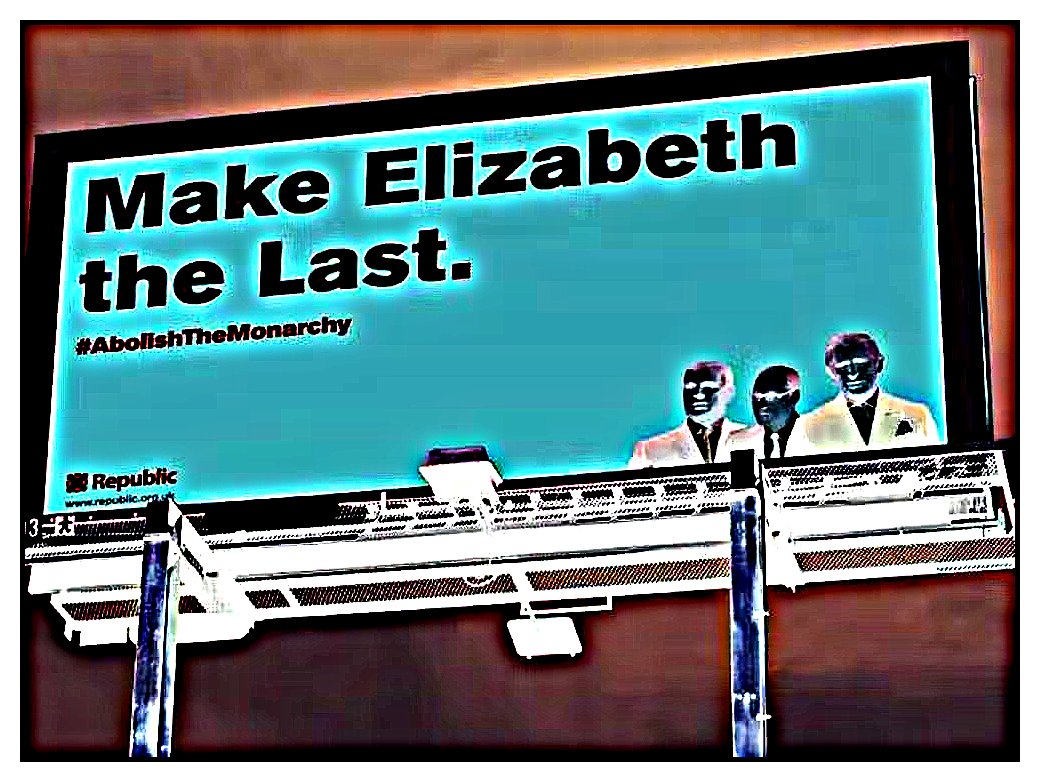
God Save The Queen.... (She Weren't No Human Being)

Royalty just ain't it used to be,
as this billboard makes amply clear...
(See links below!)


<i.>
On Monday, the world -- led by the Royal Family, among 2,000 ultra-high profile guests at Westminster Abbey -- will say its final goodbyes to Queen Elizabeth II, putting an official exclamation point to the British monarchy's longest and storied reigns. That saga came to a close on September 8, at Elizabeth's Balmoral estate, where she died at 96 -- ending a reign of 70 years, and 214 days.

Only King Louis XIV, of France, reigned longer (from 72 years, 110 days (May 14, 1643, to September 1, 1715). To put these records in perspective, e
ven such famous royal icons as Queen Victoria, and Franz Josef "only" reigned 63 and 67 years, respectively. Of the lists that I consulted, Elizabeth is the only modern figure to grace them. The closest contemporary example is King Bhumibol Adulyadej, of Thailand, whose tenure (70 years, 110 days, from June 9, 1946, to October 13, 2016) earned him third place.

And those examples are simply monarchs of states that were internationally recognized as sovereign for most (or all) of their reigns. If you include monarchs who weren't sovereign for most of their reign, the record holder is actually King Sobhuza II, of Swaziland. He ruled over Swaziland for 82 years and 254 days, from December 10, 1899, until his death, on August 21, 1982.

No one will ever break that record, I suspect, unless future monarchs find ways of cloning themselves -- or sign on for one of Elon Musk's transhumanist schemes, to interbreed man and machine. God knows, Elizabeth's successor, King Charles III, may even fund such a venture, having waited his entire adult life for the world to stop calling him "Prince." On a basic level, that must feel good, I'm sure.

On the surface, Elizabeth's funeral, and the inevitable wall-to-wall coverage it'll kick off -- starting at 11 a.m., British local time -- seems like business as usual for a nation long fed on a steady diet of imperial pomp and circumstance. That status will ramp up considerably for Elizabeth, of course, given her longevity. Waits for a glimpse of the royal coffin are now averaging 24 hours; if that metric is any marker, Brits just can't get enough of the whole spectacle.

And yet...and yet...and yet: is there really a place for it anymore? Doesn't the whole notion of some royalist clan, jet setting around the world, doing whatever vague things that they do, seem too absurd for words? Surely, all the money that's being spent to prop up the whole business could go toward better pursuits, right?


<ii.>
I posed the above questions to my newly-minted colleagues at the University of London, on my arrival there in the fall of 1990. Like any non-native, I couldn't resist popping the question: how could the concept of kings and queens, with servants always traipsing three paces behind them, coexist in a country that gave us punk, postpunk, and rave culture?

The responses I got ranged from the pragmatic ("The Queen is a useful diplomatic tool, especially in international crises"), to the social ("For many people, it's a symbol of what it means to be British"), and the purely world weary ("It's carried on so long, I can't imagine it coming to an end, honestly"). 

Still, as one of my workmates pointed out, the royalist imagery that fuels papers like the Sun meant something different in Ireland. Although Bill came from Dublin, not the strife-ridden North, he cited a more basic reason for abolishing the monarchy, or at least, severely trimming its massive estates, financial holdings, and staffs.

"After all, we were a colony, which made us part of the British Empire -- just like Asia, Africa, Australia, and India, and too many other places to count," BIll pointed out. "We didn't like it anymore than they did. And we still don't, really."


<"God Save The Queen" (Sex Pistols) 
Promo Poster, 1977: Jamie Reid>
<bbc.co.uk>


<iii.>
Of course, I can't cover this topic without mentioning one of the most famous anti-royalist anthems, "God Save The Queen." Originally titled "No Future," the Sex Pistols' second single arrived on May 27, 1977 -- just in time for the twenty-fifth anniversary Silver Jubilee celebration of Elizabeth's reign.

Not surprisingly, the song's scabrous anti-royalist blast ("God save the queen, the fascist regime/They made you a moron/Potential H-bomb") pushed varying sets of buttons, including attacks with iron bars and razor blades, respectively, against Sex Pistols drummer Paul Cook, and singer John Rotten/Lydon, the man who'd penned the lyrics ("God save the queen/She ain't no human being/And there's no future, in England's dreaming").*

The media establishment and music industry reacted by slapping a ban against the single. Widely considered the top-seller of its time, the No. 1 spot stayed blank all throughout Silver Jubilee week. That's an extraordinary response to a record that simply voiced a commonly-held resentment, as Lydon himself observed in August 1977:
"Turn the other cheek, and you get a razor through it" (an ironic comment, indeed, coming only a couple months after his attack).

"God Save The Queen" struck a chord in unusual quarters. William Burroughs, the father of postmodernism, sent the Pistols a congratulatory letter. Bob Marley tipped his hat to the movement with a 12-inch single, "Punky Reggae Party," though the Pistols didn't make its roll call of attendees ("Wailers will be there/The Jam, the Damned/The Clash!") -- quite an artistic departure for someone, by all accounts, who didn't count himself a fan of loud, guitar-driven music.

In recent years, the Pistols have offered contradictory recollections of the song that sealed their reputation. Cook has claimed the Jubilee didn't inspire it ("We weren't aware of it at the time") -- an odd statement, given the timing of the single. Bassist Glen Matlock, the song's co-author, claims to have nothing personal against the Queen, "but I do think she's a bit of a sop to what's going on," he told "Good Morning Britain" viewers this year.

By contrast, Lydon has muted his original views considerably, as he acknowledged on "Piers Morgan Uncensored," last May: "I'm actually really, really proud of the Queen for surviving and doing so well. I applaud her for that. That is a fantastic achievement. I’m not a curmudgeon about that. I just think that if I’m paying my tax money to support this system, I should have a say so on how it’s spent." 

The most straightforward view, perhaps, comes from the man behind all those overdubbed storm squalls. "I've never had any connection to the monarchy, to be honest," guitarist Steve Jones told the Independent in June. "It meant nothing to me, it still doesn't. So to me, it was just a laugh, just a giggle." The irony of the wayward guitarist being the most consistent storyteller needs no further elaboration.


<"God Save The Queen": 
Jamie Reid Cover Art)>
By Virgin Records, Fair use, https://en.wikipedia.org/w/index.php?curid=14702071>


<iv.>
The Royal Family, and what to do about them, remains a tricky subject to navigate. That's one conclusion I've drawn from Lydon's public turnabout, a move that's drawn pointed criticism from outlets like Vulture, in panning his public statement on Elizabeth's passing: "We don't know if he means it, man." (And that's one of the milder rebukes I've run across.)

Lydon's readiness to join photo opps with the likes of Nigel Farage, one of Brexit's prime movers, strikes many believers as a stunning comedown for someone they often saluted as speaking truth to power, no matter what. 
He may not be a radical leftist, the argument ran, but he's a willful anarchist. That's even better, and that makes him still one of us.

Or does it? As I've pointed out online, the 66-year-old punk icon who claims the sunny shores of Venice, CA as his primary home -- and continues to main a second one in London, while holding British, Irish and US citizenship -- has come a fair distance from the 21-year-old who once howled, "No future, no future, no future for yooouuu!" 

That distance becomes even more apparent in late '80s lyrics from Lydon's major post-Pistols band, Public Image, where a sour reactionary streak began to make itself felt in songs like "The Body" (
"Cathy, go home, forget your daughter/In a welfare state, she'll be well looked after"), and the B-side, "Selfish Rubbish," which targets the leftie crowd ("Everything in life should be free/Except the bits that belong to me").

Even so, I don't recall any reviews mentioning it, nor any interviewers pushing back against it. A little bit of mystique still goes a long way, doesn't it? It's a quality that Lydon ironically shares with the Queen he now admires so visibly. It's this factor, royal biographer Clive Irving believes, that explains the monarchy's persistence, amid all the common sense arguments voiced for getting rid of it:

"What she had to do was to maintain this strange thing that you have to maintain to keep the monarchy alive, and that’s the mystique of the monarch herself, a kind of unknowability. Here you have this paradox: One of the most famous people in the world, yet you still know so little about her, and that’s deliberate. "


<v.>
The problem with Charles, as Irving further argues (see link below) is that we know him all too well -- through his numerous, well-chronicled foibles and faceplants. In stepping up to the monarchial plate, as it were, Charles will have to call on a wealth of political and PR gifts than he's shown so far:

"One problem is that he doesn’t look like an invigorating generational shift, does he? That’s what would be needed, something that reinvigorates and sends a sense that they’ve understood the modern world. In some ways, Charles looks older than the queen. He’s a man more suited to the 18th century than the 21st, and I’m not being facetious about that. That’s his deliberate and chosen style, like a younger brother of the queen rather than a son."

Splitting the difference won't do, either as the Jesus and Mary Chain's brotherly duo, Jim and William Reid, learned in the summer of 1986, when they sat down for a provocatively-titled Smash Hits feature ("Should We Scrap The Royal Family?").

To the consternation of Creation Records boss Alan McGee, after much hemming and hawing, the Reid brothers voiced a desire for dethroning the royals without violence. ("Safe, rare and legal," anyone?) "It was the Pet Shop Boys' Chris Lowe, of all people, who said what McGee had expected the Reids to say: 'They should be publicly executed.'" (The Creation Records Story: My Magpie Eyes Are Hungry For The Prize: David Cavanagh, Virgin Books, 2000)

"And therein lies the rub," to lift that misquotation from Shakespeare's "Hamlet" -- that the monarchy's fate rests with the man widely viewed as the least suited for the job, as Irving suggests ("
I think there’s a really real risk that if Charles does succeed her that the monarchy will go over a cliff very fast"). Whether someone will create a worthy successor to "God Save The Queen" remains to be seen.

In the end, the opaque inscrutability that Elizabeth cultivated so eagerly, managed so adeptly, and worked so relentlessly, may yield the seeds that finally lead to the winding down of the monarchy that she represented so loyally, for so long. It's an irony that only an enigma might appreciate. --The Reckoner


Links To Go
(Wave Goodbye To Elizabeth, My Dear):


Down WIth Tyranny: Britannia Rule The Waves,
Britains Never Never Shall Be Enslaved...Just Enslavers:

https://www.downwithtyranny.com/post/britannia-rule-the-waves-britons-never-never-shall-be-slaves-just-enslavers

Far Out: Bob Marley's Thoughts On Punk:
https://faroutmagazine.co.uk/bob-marleys-thoughts-on-punk/


The Independent: "Make Elizabeth The Last,"
Anti-Monarchy Campaigners Urge
Ahead Of Platinum Jubilee:

https://archive.ph/UqjJt

Vanity Fair: Could The British Monarchy
"Go Over A Cliff" After The Queen Dies?:

https://www.vanityfair.com/style/2021/01/clive-irving-the-last-queen-interview


An Anti-Royalist Playlist
Attila The Stockbroker: Sawdust & Empire
:
https://www.youtube.com/watch?v=MvFqWXAAkbY

Chumbawamba: Her Majesty (Lyrics in comments!):
https://www.youtube.com/watch?v=u2d4FD9SRww

Crass: Do They Owe Us A Living? (Lyrics Video):
https://www.youtube.com/watch?v=zXh0Xw0KQ6I


Stone Roses: Elizabeth My Dear:
https://www.youtube.com/watch?v=HkfxMuOkLcs


<A Royal Footnote>
*These lyrics, incidentally, are incorrectly cited in Stephen Davis's otherwise excellent biography of Bob Marley (1983), which renders them thusly: "God save the queen/And her fascist regime/She made you a moron/And England's screaming!" Proof positive, if you need it, that it's possible hear to whatever you want, apparently, under a squadron of screaming guitars.

Sunday, August 29, 2021

Guest Post (Chairman Ralph): Here Comes Johnny Yen (And Then Some): Lust For Life, Celebrated


<https://www.superseventies.com/sppopiggy2.html>

<Intro>
I remember how and where it all started: January 1980, a lifetime away now. My dad and I were getting into one of our usual two-bit arguments about the usual two-bit teenage crap I'm halfway through high school, so you can just imagine the kind of sparring going on in the kitchen. What do you wanna be when you grow up blah blah blah what are you gonna do with your life blah blah blah have you thought about college yet? blah blah blah what about a summer job? blah blah blah you need better grades to get into a decent school blah blah blah and so on and so forth, so on and so forth, round and round the drain we circle, one more time...

At this point, I get up from my chair. All this (mostly) one-way dialogue is making my head buzz. The white noise of oncoming adulthood is ringing in my ears. Yeah, the discussion's relevant, I tell myself, but not f#cking now! My birthday's Saturday. I don't really care about anything else tonight. 

"I gotta go," I announce, without fanfare. I get up briskly, and start heading for my room, to grab my jacket. 

"Where are you going?" A flash of worry clouds my dad's face, then my mom, who doesn't typically participate in these discussions.

"Ah, the mall. I'm gonna do the usual, look at the cut-outs, the eight-tracks, the imports..." I fumble around for the keys to our '78 white LeMans. Technically, it's my mom's car, but she's not driving it much lately.

That means I can periodically "borrow" it, to hone my driving to a fine art (or finer nub, depending on my day, and mood). Theoretically, I'm preparing for my driving test, but the trouble is, my learner's permit makes it easier to put off that day of reckoning a little bit longer. Back then,you had to go out with a local cop, armed with a clipboard, ready to check off his list, and all that stuff.

Guess what, though? It's my birthday, and I sure as hell am not doing anything like that. I have other things in mind, like the punk rock/New Wave explosion that's captured my imagination, of which I'm getting a healthy fix via eight-tracks. (More about that momentarily.) I'm sixteen, dammit, and I need a suitable soundtrack. 
 
Within half an hour, I've gotten my latest fix at the mall...something called Lust For Life, by Iggy Popsomebody I've been reading about a lot lately in Rolling Stone. He curses out out his audiences, cuts himself on broken glass, flicks lit cigarettes at 'em, flips 'em the bird...and that's when they're sufficiently appreciative, and actually paying attention. Imagine what he does when they're spacing out!

Anyway, the various album reviews, live reports and interviews trickling into my vision through Rolling Stone, and whatever mags I'm picking up at the grocery store make all these antics sound interesting. It certainly sounds way cooler than what I'm used to seeing -- hairy guys with pornstaches, hiding banks of amps and keyboards, through which they crank out the lamest, most inoffensive, middle of the road sounds imaginable. 

Whatever, I tell myself, as I slide Mom's LeMans into the driveway. At this point, I don't need any convincing. I'm in.


<"He's Nude 'N' Rude..."/The Reckoner>

<ii.>
Here I am now, I'm grooving to Lust For Life in my bedroom. One song, in particular, captures my attention, driven along by a nagging, yet undeniably catchy guitar riff, that goes something like this:

<BUM-BUM-BUM, 

BAH-BUM-BUM-

BA-DA-DAH-DUM...>


Cool as it is, that riff wouldn't mean anything without that whomping drum intro that Hunt Sales whacks out on his kit. Every time I hear it, I think, this is how drums should sound, big and strong. Even on headphones, it sounds like you're in the room with him, as brother Tony's bass falls in, followed by the respective rhythm and lead guitars of Carlos Alomar and Ricky Gardiner.

Next come the Burroughs-inflected lyrics ("Here comes Johnny Yen again, with the liquor and drugs/And the flesh machine/He's gonna do another striptease") that Iggy barks out with a staccato urgency ("I've been hurting since I bought the gimmick/About something called love, something called love/Well, that's like hypnotizing chickens"), because he's got somethin' to tell ya, anyhowIggy was fresh from two years in the wilderness, following the breakup of his pioneering band, The Stooges, with The Idiot (1977), whose dark narcotic throb propelled him back into the public consciousness. 


<"Come In, Nipper (You've Met Your Match At Last...)/
The Reckoner>

<iii.>
Sure, he'd spent much of those two years struggling with drugs, and sleeping on peoples' couches, surfing the margins without a record deal. But this time around, he's determined to do better, as he tells you later: "Yeah, I'm through sleeping on the sidewalk/No more beating my brains, with liquor and drugs/No more beating my brains, with liquor and drugs." Lawd have mercy!

Making those promises is one thing, of course. Making them stick would take a decade and a half or so, but no doubt about it, "Lust For Life" signaled a new attitude, a notable shift of priorities. From my perspective, it's getting the job done. My head's no longer buzzing with arguments about college or grades or summer jobs or what I "should" be doing with my life. The white noise of oncoming adulthood is no longer ringing in my ears. I've forgotten all about what Dad said.

Right now, I'm just sitting on my bed, savoring another song that's caught my ear. It's "Sixteen," your classic ode to teenage jailbait, more or less ("Sweet 16, in leather boots/Body and soul, I go crazy/Baby, I'm-a hungry'), driven along by a nagging cowbell and trash can-sounding guitar. 

Iggy's normal baritone croon is now a cracked-sounding yelp that ripples through my primitive eight-track player speaker ("I'm an easy mark, with my broken heart"), and I couldn't care less about anything else. I'm turning 16, listening to a song called "Sixteen," and right now, nothing else matters, full stop. This is how that unholy duo of Iggy Pop and Lust For Life entered my home. 


http://www.collectorscum.com/8tracks/

Not mine, obviously, but nice to see...

<iv.>
No doubt about it: how you perceive the likes of Lust For Life depends on when and where you first came across it. In Iggy's case, I imagine countless millions found out through Trainspotting's opening sequence of its junkie trio dashing through Edinburgh's mean streets, or that Royal Caribbean Cruises ad, to name two of the higher-profile corners that they've probably heard "Lust For Life," the song. 

My experience was different, as I've noted. Scoring Lust For Life on eight-track wasn't my goal, but I couldn't always fork over the $6.98 list price that most new releases normally commanded then. But sometimes, you could scoop up the eight-track version for at least a couple bucks off, making them an attractive fallback, even if the format restrictions (11.5 minutes per track, 46 minutes total) meant that your favorite song often got chopped in half.

They weren't always in great condition, either. Sometimes, you'd get only get half a dozen or so plays before the tape broke, forcing you hunt down another copy, if you felt motivated enough. Even so, I'd just gotten an eight-track player for a Christmas gift, so I needed to feed that particular beast, anyhow. Without eight-tracks, I wouldn't have heard the likes of Elvis Costello (Armed Forces, My Aim Is True), Bob Marley (Babylon By BusBurnin'Natty Dread), The Police (Outlandos D'Amour), Talking Heads (Remain In Light)., and -- Lust For Life, to name a few.

Eight-tracks also exposed me to less obvious fare, like UK's self-titled debut album, for instance, and a lot of '60s-related fodder, such as The Best Of The Electric Flag (1971), which marked my first taste of Mike Bloomfield's supernatural guitar wizardry, and inspired me to track related albums, like Live At Winterland (1969), and My Labors (1970), on dust-coated cutout cassettes. (Both tapes broke quickly, though, so I wouldn't get to hear them in full until 20- or 30-odd years later.)

You had oddities, too, like this tape of off-brand Saturday Night Fever soundtrack covers I got that Christmas, along with my eight-track player. Hearing those journeymen Bee Gees wannabes struggling to hit those high notes on something like "Night Fever" ("We know how to do it for-EHHH-VERRR, can't you feel it?"), and never quite making it, provided hours and hours of cheap yuks. Nice try, boys, I'd chuckle, but no cigar. And then came Iggy.


<
http://www.collectorscum.com/8tracks/>

Never saw THIS ONE gracing
any bargain bin...oh, well.


<iv.>
"Lust For Life," of course, is only one jewel on an album brimming with them. As he'd done on The Idiot, Bowie played a major hand in the music -- co-writing six of the eight songs here. But Iggy also took a more direct musical role than he'd done on The Idiot, with crucial support from the band. This policy led to a looser, more collaborative ethic, with Iggy improvising lyrics with each take. (Bowie would borrow this technique, like he did so many things, for his next album, Heroes.)

Gardiner supplied the insistently catchy riff for "The Passenger," which falls into the "I Am A Camera" sub-genre of Iggydom. Basically, it's Iggy Pop as observer of the human condition ("He sees the stars come out tonight/He sees the city's ripped back sides/He sees the winding ocean drive"), as he casts a frown around the cityscapes that excite (and oppress) him at the same time. 

Gardiner, along with Bowie, also co-wrote one of my other personal favorites, "Success," a rollicking throwdown to the joys of going for it ("Here comes success/Here comes my car/Here comes my Chinese rug"). Like "Lust For Life," it's built around a rollicking call 'n' response riff, with the band repeating each lyric to increasingly hilarious effect, as Iggy ups the ante near the end: "I'm gonna out into the street and do anything I wanna...OH, SHIT!Hearing the boys struggling to keep up, as Iggy sings those lines faster and faster, still cracks me up, all those 40-odd years later. 

Gardiner's blunderbuss guitar style also lends an air of throbbing menace on two other rockers -- "Neighborhood Threat," and "Some Weird Sin," whose dark, droning chord sequences (E-flat, F-sharp, G-sharp, B-flat) complements its "If you're skating on thin ice, you might as well dance" sentiments.  The mood darkens considerably on "Tonight" ("I saw my baby/She was turning blue/I knew that soon her young life was through"), which offers a loving tribute to a partner about to expire from an apparent overdose ("I will love her till I die/I will see her in the sky/Tonight"). It's powered by a piercing lead break from Gardiner, and swirling keyboards from Warren Peace (a/k/a Geoff MacCormack).

"Give the keyboard guy some" seems to have been the primary reason for Warren Peace's sole co-write, "Turn Blue," seven minutes of slow-burning, spleen-baring that I'd appreciate more, if I only knew what Iggy's actually going on about. At various points, he pants over a woman in a black El Dorado ("That black girl in the back looks pretty good"), then rapidly free associates through references to Jesus ("You might as well come with me"), and drug abuse ("Oh, Momma, I shot myself down").  Is he victim or villain? Who knows? I can listen to this song, if I'm in the right mood, but to put it another way...I didn't mind seeing this one cut in half. (For more info, see the Pushing Ahead Of The Dame links below -- both being must reads!)
"
Fall In Love With Me" -- the other epic here, at six and a half minutes -- works way better, due to its conceit of making each musician play an instrument they didn't already know. (Bowie also borrowed this idea for "Boys Keep Swinging," on his '79 album, Lodger.) Hence, Gardiner deputizes on drums; Hunt Sales, bass; and Tony Sales, guitar, burnishing the "fall apart any minute" mood at work here. It's a celebration of Iggy's German girlfriend of the time, Esther Friedmann, so there's nothing to think about too deeply, but it's a fine ending to a fine album.


<Dutch single, 1977: RCA Records>

<v.>
For all his newfound purpose and creativity, Iggy found himself in his usual spot: ahead of his time, and falling between two chairs at the box office. Lust For Life received little promotion from RCA on its release (August 29, 1977), a mere three weeks after the death of Elvis Presley, whose catalog received far greater attention (to put it mildly). Once its first pressings sold out, the album became hard to find, as Tony Sales told Iggy's biographer, Paul Trynka: "Lust For Life just disappeared from the shelves, and that was it."

As a result, Lust For Life peaked at #120 US, a considerable notch down from The Idiot (#72 US). RCA pulled only one single ("Success"/"Sixteen") in September, that made no impression whatsoever, and called it a day. Reactions overseas proved predictably stronge -- including the former Yugoslavia, of all places, and Holland, "Lust For Life" earned a #3 chart placing. The parent album peaked at #28 UK -- just two places above The Idiot, which had given Iggy his first Top 40 foothold.

In hindsight, it's hard to think of fewer albums that I liked better, yet weren't so celebrated at the time. RCA's apparent indifference is all the more grating, when you consider the purple patch of creativity that Iggy and Bowie were experiencing in '77. That stretch kicked off in January 1977, with the release of Bowie's album, Low -- followed by The Idiot (March '77), the Lust For Life sessions (May to June '77), and album release. 

Appropriately, the year ended in November '77, with the release of Kill City, overseen by former Stooges guitarist James Williamson. He'd recorded it two years earlier with Iggy, who did his vocals on weekend leaves from a mental hospital where he was staying, to beat his long -standing heroin addiction. 

The pair had intended it as a demo, in hopes of striking a new record deal, but no takers emerged -- until The Idiot and Lust For Life provided the obvious cues. Add in the usual ongoing tasks of demoing, rehearsing, and touring, and you're left thinking:

For guys who wanted to convince you they were decadent vampires, it's tough to imagine a pair of night stalkers who worked as hard.


<Iggy Pop Versus The World, Take I/
The Reckoner>


<Coda/Over 'n' Out...>
But all the commercial metrics of Lust For Life's performance obscure one other reality -- while mainstream audiences largely shrugged, those who bought it became ardent converts, who often became became groundbreakers themselves. For example, Paul Westerberg briefly played in a band called Neighborhood Threat, on his way to becoming the Replacements' frontman and songwriter. 

Bowie also recorded "Neighborhood Threat" and "Tonight" -- as a duet with Tina Turner, minus the drug references -- to no particularly great effect on Tonight (1984), which ties the inappropriately-named Never Let Me Down (1987), for the Starman's worst piece of platinum-seeking cow poop -- but the results reportedly bailed Iggy out of a tax debt to Uncle Sam. Even if the results were excruciating, I could support that cause, and if you notice a drop in quality, son, that's neither here nor there.

Not surprisingly, much of that action has revolved around "Lust For Life," the song -- which first began appearing in films like Spetters (1980), a gritty Dutch language dirt biker drama, and Desperately Seeking Susan (1985). "On Lust For Life, the drums sound not huge, but massive!" New Order's drummer, Stephen Morris, noted with vivid enthusiasm:

"The loudest cymbals known to man, that riff! I wanted to sound like that, still do."

It's hard to imagine a better tribute, though I honestly don't need it to validate my experience, anymore than I need the Royal Caribbean or the Trainspotting images, nor all the various covers that have emerged over the years, nor all the assorted documentaries and TV shows and videos purporting to have uncovered that proverbial 800 feet of tape that somehow explains it all. 

Maybe Iggy and company didn't have work that hard to win me over, because by this point, I was actively reading magazines like CREEM and Rolling Stone, not to mention more highbrow establishment bastions like TIME, trying to get more and more of my hands on a piece of this so-called punk 'n' New Wave action that was firing my neurons into eternal overdrive. 

But it's hard to imagine fewer records that hit me harder -- once the Clash and the Sex Pistols dropped that potential aitch-bomb into my brain -- or grabbed me tighter by the throat. Lust For Life stands up, simply because it reminds you of what's possible, and then proceeds to deliver on that promise, rather than reneging it, like so many releases did (and still do). Copout isn't on the agenda, full stop.

And once that realization drops, like it did it for me on that rickety eight-track speaker so long ago, one other realization hits: No more looking back, because this is the real deal. Once you're in, you're all in, and whatever you do, don't settle. That's the moral of the story here, as far as I'm concerned.

So much for my history lesson; what you do with it is your business. Now, if you'll excuse me, that flesh machine needs my urgent attention. And I've really gotta get back to hypnotizing me some more of those chickens. --Chairman Ralph


Links To Go 
(For All You Modern Guys...And Gals):
A Pop Life: Lust For Life:
https://en.apoplife.nl/iggy-pop-lust-for-life/

CollectorScum.com: Punk 8-Tracks:
http://www.collectorscum.com/8tracks/
(Lots of cool eight-track pics, plus some neat related stuff --
check it out!)

Iggy Pop's "The Idiot":
http://idiotlust.blogspot.com/


Pushing Ahead Of The Dame: Lust For Life: