Showing posts with label hipsters suck. Show all posts

Monday, February 24, 2020

Pay To Play Culture 101: Submission Fees Suck (Just Say No!)

<"Dream big, kids! Starts at two bucks a pop...>
<quickmemes.com>

<i.>
Once upon a time in Rock 'n' Rollville, life moved at a straightforward clip. Bands played shows, "X number of sets for X dollars," for fees that the club owner or promoter adjusted up or down, depending on how drinks sold, and how many punters turned up. If you'd built up a big enough audience, and managed to put out a record or two, you might manage to wangle a guarantee out of the guy. (This being the '70s, it typically was a guy.) Or you might end up with a deal that guaranteed X amount of money upfront.

If your star was
really hot, you could play two or three weekends a month, which might make enough -- after paying the band, booking agent/manager (if you'd landed one), and incidentals like food, gas, guitar strings -- to avoid working at the loading dock or the mall, God forbid. Theoretically, it meant your dream had enough legs to move up the ecosystem of small halls, then mid-sized theaters, maybe even arenas, who knows?

By the 1980s, though, a different business model slowly took hold, starting in the Los Angeles, CA area. Club owners and promoters began requiring bands to buy X number of tickets, to guarantee X number of attendees. Or it might mean paying (a hefty) X amount of dollars upfront to rent a venue, or enter some Battle of the Bands, for those hoping to work that angle.


No matter angle they worked, though, the powers that be pushing it made out. They covered all their costs. Hopefully, the musicians might sell enough tickets to make the arrangement pay off, before they'd earn a nickel from their night's work. These practices are commonly called "pay to play," which invokes a sports analogy, as its name suggests: 
Wanna get in the game, kid? Here's what it'll cost ya. What's it gonna be?


Just Say No...

<The Reckoner>


<ii.>
Nowadays, there are no shortage of pay to play schemes, and variations  to capitalize on them. Search online, and you'll find everything from corporate-co-opted film and music festivals, where you pay to get considered for a shot at playing there, or showing your work. Much of this model focused on SonicBids, though its hipness quotient and relevance seems to have cooled off markedly, judging by the research that I've done.

Got a competitive spirit? There's plenty of film, literary or music-related contests, promising some moon shot or other -- a publication here, a $1,000 prize there -- once you fork over the relevant fee. Hoping to become the next Hans Zimmer? New platforms are popping up all the time to serve that fix. Just submit Tracks XYZ to Middlemouth ABC. If he or she finds a buyer, they get a cut. Everybody wins, right?

Think you're the next Bukowski in waiting? That's the focus of Submittable, which major and minor rags -- from the Harvard Review, to Playboy, Debt-Ridden U. Review, and beyond -- are using. Think of it as SonicBids for the literary set. Click the relevant listing, cut and paste your bio, contact details and submission into the box, shell out whatever "reading fee" they want. Hit "Send," and you're done. 

Quick and painless, right? Beats pounding out your latest masterpiece on a typewriter -- for those who came of age in the pre-digital day -- and shelling out the postage, including self-addressed stamped envelope, and then (at last!) schlepping it off to the post office. But is it really?

I remember Writer's Market advising, back in the '80s, to submit at least 50 poems at any given time. If you check the Submission Fee Blacklist (see below), $2-5 seems the going rate (though some charge way more). At five poems per outlet, that's $10 to $25 a pop. When you consider that many journals pay only in copies, or a token amount -- as little as ten bucks, in some cases -- the deal stinks even higher to Heaven. Especially if submission fees become the new normal.


<iii.>
So what's wrong with submission fees, exactly? Let's count the ways, shall we:

1. "We need them to keep people in check." Actually, I've seen the opposite happen, on the music side. Slapping fees on anything doesn't discourage the rich kid-fronted band -- or the hobbyist who's got a great corporate job -- from plugging away, when they really should throw in the towel.

They'll grumble, but they'll pony up the money, because that's what our reality show-driven culture teaches them, and us (Success trumps self-satisfaction). The mom juggling multiple jobs with the Great American Novel is less likely to peck away, especially if she's faced with constantly choosing creativity over food and medicine.

2.
"We need them to keep our contest/festival/publication afloat." There are better business models out there than treating talent like a revenue stream -- such as GoFundMe, Kickstarter or Patreon, for openers. Those platforms have their issues, too, but appealing directly to a potential audience sounds better than joining pay to play culture, doesn't it? At least, I think so, anyhow.

3. "We need them to raise credibility and professionalism." I might believe that one more, if everybody actually rushed to tell what us what they do with the money.  All outlets, I feel, should disclose their acceptance rates. What percentage of those submissions make it off the slush pile? And if they split those fees with somebody, they should come clean there, too. That way, if you still plunk down the money, you're at least making an informed decision, not just pissing in the dark.

4. "We need them to reduce the slush pile." A lot of editors fall back on this chestnut as their "get out clause." But the slush pile is usually the last rock that anybody turns. Most filmmakers, musicians or writers with any kind of profile often got there via the side door -- as in, a connection or relationship with so-and-so, that enabled them to bypass the fees, and the plebs who pay them.

And honestly, most gatekeepers aren't exactly toiling at the salt mines. I learned this lesson back in the '90s, after submitting a proposal on a friend's behalf to some cooler-than-thou-indie-or-other (think: bastard son of Loompanics). When it came back, I could see the decision maker's thumb and forefinger imprinted firmly in our pitch letter. There were no imprints anywhere else in our proposal. Such is life.


<iv.>

I've had mixed experiences, at best, in the play to pay arena. As I've documented in the "Jobs To Nowhere" series, I played overseas in a band, and we actually made that system work -- to some degree -- by vigorously pushing our co-workers, significant others, and whoever else we could round up at our gigs. On the other hand, I've rolled the dice on a couple of tries in the Submittable pond, without any returns.

Those scenarios fall under pay to play culture, which means that you're never in charge of your own destiny, because the ball is always in someone else's court -- in this case, somebody who ruled out sharing the proceeds with you, at least initially (and only if they like you). Somebody who can stack the deck as they please, without having to tell you how they cut the cards. And somebody who doesn't have to tell you where the wealth is actually going.

"But wait," I hear you say. "What's the problem? Submission fees are just a means to an end." Just remember, though: once the "new normal" takes hold, it doesn't take long to get seriously abnormal. As Atlantic notes in its article, the indie mags that hoped Submittable would remain free -- as its founders initially promised -- are now pondering fees just so they can afford to use it. (The resident wise guy is tempted to jibe: "You've heard of email, right? It's free.")

And that's my biggest problem. Pay to play culture is corporate culture, with all the baggage that implies. By nature, it can't coexist with DIY culture, which has no use for fees, let alone the gatekeeping systems that become addicted to them. To ignore it is to allow the long term devaluation of our work, and the swapping of creativity for convenience and corporate control. Still, it's never too late to draw your own conclusions, as one of my friends wryly about writing contests: "I stopped doing them when I realized that the favored local writer always seemed to win." --The Reckoner


Links To Go (Hurry, Hurry,
Before The Cost Of Your Dream Shoots Up):
Fear-Free-Film Fundraising Blog:
http://fearfreefilmfundraising.com/2014/05/fees-chumps-dont-pay-hit-submit/


Lit Reactor: Publishing: Submission Fees:
https://litreactor.com/discuss/submission-fees

Medium.com:
Why I Don't Use Pay-to-Submit Music Sites:
https://medium.com/@GoGirlsMusic/why-i-dont-use-pay-to-submit-music-sites-and-5-better-ways-to-invest-in-your-career-47eaa3aa2dcc

Tech Crunch: Submission Management Startup
Submittable Raises $5 Million:
https://techcrunch.com/2017/06/13/submittable-series-a/

Tech Crunch: YC-Backed Submittable
Makes It Easy For Writers To Manage Submissions:
https://techcrunch.com/2012/06/18/submittable/

The Atlantic Monthly: Should Literary Journals

Tuesday, December 31, 2019

Windy City Snapshot: The Article That Never Ran


<And an anti-New Year to you, too...
I drew this graphic at 15,
May 1979, when stuff like
Lou Reed and the Velvet Underground
formed essential building blocks
of my high school soundtrack.
It fits the vibe here, I think.>

<"I mastered the art of recording 
known as 'capture the spontaneous moment 
and leave it at that'. The Bells was done like that, 
those lyrics were just made up on the spot 
and they're absolutely incredible.>

<"I'm very adept at making up 
whole stories with rhymes, schemes, jokes."
Lou Reed, CREEM, September 1980
("Lou Reed Tilts The Machine">


Reckoner's Note: During my Windy City era, I kept busy freelancing for all sorts of national music rags, from the technical (Guitar Player) to the retro (Goldmine), to the general (coffee table reference guides that needed lots and lots of entries, like, yesterday, man). When that era started, I also figured it would make sense to try and get some local action, too, in case the national stuff dried up.

Alas, though, it didn't work out that way, as the following piece might indicate. I wrote it back in 1996-97, but it's never seen the light of day -- until now. This era coincided with the rise of alternative weeklies, who prided themselves on cranking out stories that The Man (as in, mainstream media) either forgot about, or flat out ignored. This was the place to start, if I wanted to do any local freelancing. Or so I was told.

I approached several outlets, but the one mentioned below (City Vibes) was the only rag to respond. Or not respond, which is what I ended up writing about, to salvage the situation -- this piece came during an era when I paid 30 cents a shot, even for local calls! 

But none of these issues satisfied the folks at City Vibes, who refused to pay. I didn't expect the full shot, by any means, but I felt my time deserved something. After all, major mags pay "kill fees" all the time, on stories that don't run, for just that reason. But not in the Windy City, apparently. I said something like, "Go fly a kite," and I never approached any of the alt-poobahs again. I  kept doing my national stuff, and never looked back, as the saying goes. 

Of course, the bloom has long fallen off the alternative weekly rose, as you'll see from the links below. But I refuse to join the Viking funeral, not only because their time has come, and gone -- and more outlets have sprung up to replace them -- but from a simple truth.

If you don't feel like answering the phone, or paying for my time, don't expect me to wear out my lips kissing you all goodbye. 
The piece follows below. As usual, all the names have been changed, to avoid retribution from the guilty. Make of it what you will. --The Reckoner


THE VILLAGE PEOPLE PUNK OUT (AND I GET TO HOLD THE CHECK)
I only wanted the just the facts, but all I got were just the flacks. So it went when City Vibes deputized me to buttonhole those notorious '70s bad taste icons, The Village People, currently headlining an all-star disco demolition over The Trammps ("Disco Inferno"), and KC & The Sunshine Band ("Boogie Shoes," "Shake Your Booty," and too many others to mention), on March 29 (Star Plaza Theater, Merrillvile, IN), and March 30 (The Rosemont, Chicago).

"No problem," Star Plaza's Marketing Maven reassured me, in late February. "I'll pass on your request to the Village People, and they'll call you." The mind boggles. At last, I get to pop choice nuggets, like, "And when did The Cop take a hike?" Three weeks dribbled away: no Village People, no response. Maybe they'd misplaced their Rolodex?

Take two, Monday, March 15. "I've called, but there's no answer," the Marketing Maven assures me. "Well, my girlfriend's usually here, if I'm not," respond. A length pause follows: "Oh." 

Take three, Friday, March 19: I get A) Star Plaza directions, B) travel/ticket information, C) a plug for group discounts, and oh, yes, the Marketing Maven's voicemail. But she's not there.

Take four, that same Friday: I left a message with the Rosemont's PR flacks, figuring the locals might cooperate more. No such luck, though. I guess they don't need to return my call, let alone risk the publicity.

What a unique response -- this from a group who hammered three chart grand slams in "Macho Man" ($25, 1978), "YMCA" (#1, 1979; two million US, 12 million worldwide sales); and "In The Navy" (#3, 1979), before bottoming out with "Go West" (#45, 1979), and "Ready For The '80s" (#52, three weeks, 1/80). 

Maybe "The Peeps," as many reviewers affectionately tagged them, want us to forget such milestones as their double-LP, Live & Sleazy, or Can't Stop The Music, possibly America's only pro-disco musical, starring Nancy Walker.

Of the original Peeps, lead singer Victor Willis (The Cop), and Randy Jones (The Cowboy), have since left the group, whose fearsomely-styled costuming (including a biker, GI and Indian, among others), and cartoonish bump 'n' grind remain a pleasant night out, primarily on college campuses. If you go, expect no surprises.

One last tidbit: The Wacky Top 40 (1993) now contains a corrective statement for anyone accusing the Peeps of nasty Milli Vanilli-style live lip sync: "The Village People have responded uniformly to such rumors by making it clear that they sang live in all their concert settings for the last 17 years."

Feel better? I hope so, and for those who doubt me, The Star Plaza and the Rosemont  do have the finest voicemail systems I've ever encountered. Too bad they don't talk back.

Links To Go (Hurry, Hurry,

Your Favorite Alt-Weekly's Hit The Funeral Pyre):

CityLab: Making Peace
With The Decline Of Alt-Weeklies:
https://www.citylab.com/equity/2013/03/making-peace-decline-alt-weeklies/5043/

Governing.com:
Mourning The Decline Of Alt-Weeklies:
https://www.governing.com/topics/politics/gov-local-news-alt-weeklies-watchdogs.html

Reuters:
The Long, Slow Decline Of Alt-Weeklies:
http://blogs.reuters.com/jackshafer/2013/03/15/the-long-slow-decline-of-alt-weeklies/

Sunday, November 3, 2019

When Open Mikes Aren't Open Anymore: Three Snapshots


<i.>
Generally speaking, I don't do open mikes. For an example of the hiccups that occur, see my other post below, "The Never-Ending Open Mike (Two Surreal Case Studies)." I'm not saying the problems that I cited happen all the time, or my experiences have always been subpar. The situations I encountered simply hardened my resolve to find better outlets for my music and spoken word material. After all, it's hard to showcase your abilities when the showcase itself goes sideways.

Lately, though, I've seen some odd terms and conditions popping up, when I've wanted to participate. Imagine the Riddler posing one of his preposterous jokes, wagging his finger at Batman's campy '60s incarnation, or the darker ones currently making the cinematic rounds: "Riddle me this, Caped Crusader. When is an open mike not so open anymore?" To which Batman strokes that famous rugged jaw, furrows an eyebrow or two, then snaps his fingers, and responds with the following three examples.

Exhibit A: Sounds Good (But We Gotta Vet Ya First): Back in the summer, I'd recorded three songs at home, and thought. Hey, why don't I try these out? Can't do any harm, right? That's the most common reason for doing open mikes, right? Road-test your new material in front of a real crowd, keep your chops up, that sort of thing. In this case, you had to e-mail the venue in question ahead of time, which I did. Here's the response I got back:

Thanks for your message regarding open mic.

Please send along a sample clip of what your performance would be - either video or audio. Thank you.

I found this response baffling, since it begs one obvious question: well, if you're just gonna cherry pick who you want onstage, anyway, it's not really an open mike anymore, is it? Then it becomes something else, but not an occasion that fits the alleged purpose of open mikes: a place where all comers can play whatever they want, while getting a chance to meet, and swap phone numbers and/or ideas afterwards.

Needless to say, I didn't send a thing.


<ii.>

Exhibit B: You Gotta Pay (If You Wanna Play): The same venue cited above (we'll call it Cardboard City) also runs a poetry/spoken open mike, which I've done three times. I was looking forward to the same opportunity again this week, until this sentence from the press release stopped me dead: "$5 minimum donation please. Donations support our non-profit arts organization." It's not clear to me whether this policy applies to everybody, or just those watching the performers, but on its face, this sentence skirts the edges of paying to play.

Pay to play is most commonly associated with sports leagues and music venues. The term refers to the practice of requiring an upfront fee before the performer can take the field or the stage. Musicians first encountered pay to play in the 1980s, at venues in Los Angeles, CA. (Typical variations involve buying X number of tickets in advance, or guaranteeing that "X number of people will show up.") Pay to play is less controversial in the sports world, especially in local leagues, where few, if any parents will quibble about the price of signing up Little Johnny and Suzy for soccer.

I'll have to investigate how Cardboard City applies its donation policy, but my only issue is the connotations it carries for performers, who already face enough barriers to entry -- and doing our "thing," whatever that means -- without our wallets getting thrown into the mix.

Exhibit C: Shut Up And Sing (Just Don't Annoy The Regular Folks). I came across this example while preparing an entertainment calendar for one of the publications that uses my writing. The verbiage reminded me of the Dixie Chicks documentary, Shut Up And Sing (2003), which chronicled the outcry that greeted the band for its relatively mild denunciation of then-President George W. Bush. Given the ferocity of Trump's fanbase, imagine what would happen now, if a similar band declared itself "ashamed that the President is from New York"!

Anyway, here's the relevant language from this venue (we'll call it The Stable), in all its one size fits, opaque glory:

Please be respectful with your material. While we want to be open with our stage and invite all forms of art, it cannot be at the expense of others. This is not a night for improvisation or a political platform, but a chance for all to enhance their crafted art skills. Thank you. I have a few issues here, starting with the obvious: What does "respectful" mean, and who gets to define it? Presumably the host, though it's not exactly clear. Judging from the next sentence, it's fair to say that any Dixie Chick-style verbiage is verboten, and you'd probably check your improv comedy styles at the door, too. After all, we wouldn't want anybody riffing off Trump's latest pipe dreams, or Phil Ochs's "Love Me, I'm A Liberal," would we, now?

I'm not sure what kind of open mike is being promoted here, unless it's the Comfy Cozy Coffee Set. Considering how dark, dangerous and desperate our times have grown -- and not only politically, as the California wildfires are demonstrating this weekend -- it's a little bit much to insist that musicians, in particular, just stare straight ahead and keep their mouths shut. Sorry, but if all we've done is just stay in a bubble, and simply talk shop, then not much has happened.

One quality that these examples share is the apparent lack of trust underpinning all of them. What's really strange is that open mikes aren't paying gigs (except for the host), so if there's no money -- no guarantee, no tip jar -- changing hands, what's the problem? It's not as if I've seen anyone at either venue counting off the MC5's signature song: "And right now, it's time to...kick out the jams, motherfuckers!"

Happily for me, I'm not going to deal with the fallout from these practices. I've been asked to perform at a church dinner with someone else a couple Saturdays from now. Aside from one suggested song ("This Land Is Your Land"), our minister is letting me work out the rest -- as it should be, since I've played there before. No advance clip, no minimum donation, and no admonition against airing inconvenient opinions needed. Maybe I'll check back and see how the above venues evolve -- or don't -- but I'm doing what makes me happier. Which means staying off the Open Mike Highway, at least for now--The Reckoner


Links To Go (Hurry, Hurry,
Before The Sandman Gives You The Hook):
The Never-Ending Open Mike (Two Surreal Case Studies):

Showtime At The Apollo: Sandman Fight:

Gigs And Bands (UK): Five Reasons Why
Open Mic Nights Are Killing Live Music:

(Plenty of food for thought here -- written to irritate, so bear that in mind, but lots of interesting pros and cons in the comment section, so have fun!)

Saturday, January 19, 2019

The Never-Ending Open Mike (Two Surreal Case Studies)

<Yer Empty Room Awaits...
...This Ain't The Magical Mystery Tour!>

<i.>
Whether it's spoken word, standup comedy or singer-songwriter (to name the Three Obvious categories). if you've got a talent, you've probably encountered The Open Mic (or Open Mike). You know, those revue type of affairs where all comers strut their stuff for whoever's crying in their beer (or coffee), usually for 10 to 20 minutes. 

Under the right conditions, this proposition can pay off, especially if you hit the sweet time slot spot. That's an art in itself, as any performing lifer knows. Sign up too soon, and you'll break out that flamenco-flavored Rod Stewart cover as people straggle in. Sign up too late, and you'll stare down an empty room as fumble through your opus about Amelia Earhart's last flight.

Grab the halfway mark of a three-hour night, however, and chances are, you'll still have a packed crowd -- or at least, a decent-sized, halfway enthusiastic one -- for whom you'll pull out all the stops. The response may help you land a paying gig, if not the promise of one. If you're just starting out, there's no better way to develop the skills you'll need to win people over.

That's the positive side. Now let's examine the flipside, with two surreal case studies, drawn from hard-fought, hardbitten experience.


<ii.>
It's 5:30 p.m. Sunday, in Small Town Indianaville. October has settled, crisp and cool, here. You've just rolled up to the venue, a small, boxlike coffeehouse that you've played this summer to about 50 people. The response to your half hour set proved encouraging enough to get invited back, though as a hoist.

Things come unstuck right off the bat. Tonight's headliners, the all-instrumental Pitch Black Troika, ask to play first. Something about another gig that they've booked somewhere else tonight, that requires some travel trime. You think they'd review their calendar more keenly, right? 

But the promoter says okay, so you duly introduce them, and get out of the way. Pitch Black Troika sounds hot, loud 'n' crunchy, though your mind circles back to that nagging question: why do they want to leave so early?

Once their allotted 45 minutes is up, they slide out the door, and their following slides out with them. The house shrinks from about 80 people, give or take, to just half that number. Now the promoter asks you to play. Huh?  

Guess what? He must have seen his headliner's alibi coming, because he's apparently booked several solo guitar performers, just in case. None of them have arrived yet, so he's got time to kill. Lots of time. You grimace, but agree. Don't want seem like a bad sport, right? Which is you end up getting your own 45-minute set.

The penny drops as the last-minute additions finish straggling in. Seems you were the only one who brought a real, working microphone -- but none of the stragglers did, which means ...they want to borrow yours. The promoter asks if you mind. 

You do mind, because 10 p.m. is creeping up fast. You have an hour-long drive home, and a couple interviews to do tomorrow. The crowd has dwindled to about 30 diehards and their reluctant boyfriends or girlfriends drafted to film or record so-and-so's set for posterity. What started as a gig, at least theoretically, has wound down into...the never-ending mini-fest. Or never-ending open mike.

"C'mon," you plead, gesturing at the sea of empty tables. "I've got stuff going on tomorrow." You gesture again. "This is painful. Why don't we just call it a night?"

Nothing doing. The promoter claims he that promised to provide everybody some sort of adequate sound, so your mic is Plan A, B and C. You slump into a chair as far from the stage as possible, as the minute hand drags toward 11:00 p.m., and then....midnight, and finally...1:00 a.m. 

Only a dozen diehards are left. You finally get the high sign to pack and leave, gritting your teeth through the usual after show BS ("Yeah, I really enjoyed myself tonight. Sure, I'll come back any time."). At least you won't have to beat the traffic, right? That's a positive, though it's the only one, after tonight's train wreck.


<iii.>
On the ride home, your mind flashes back to a similar experience. This one happened about five years before tonight, at a legendary venue in downtown Ann Arbor. It's a reliable schedule filler for alternative folk/rock legends like Alejandro Escovedo. So it's definitely got the Cool Factor going....if you can crack the usual gatekeeping stuff.

At the time, you lived 90 minutes south of Ann Arbor, so heading there didn't seem like a stretch. Maybe you could make a semi-regular gig of it, depending on your work schedule -- but there's a catch, as you and your small circle of musician friends find out, after you arrive.

A few questions are all it takes to fan the dismay. Yes, the host confirms, we're technically open at 6 p.m.. But open mike doesn't start till 8 p.m(There's usually a "but" in the music business.) You guys will have to wait for signup until then. The giant double doors shut with a thud, leaving you all sprawled across the giant staircase and its imposing steps.

Time grinds slowly enough at work. Now this scenario, once you've exhausted the standard topics (what shows have you caught, what are you listening to, just why are we sitting here again?), the minute hand creeps toward its usual soggy conclusion.

At last, the appointed hour arrives, the doors wheeze open, and the jockeying begins for the best time slot -- a forgone conclusion, though, now that the regulars have arrived. They flash a knowing look: don't you know this setup works? Poor, poor pitiful you.

You end up playing between 10:30 and 11:00 p.m.-ish. You're tired and stiff, and once again, the usual hustles make themselves felt. The room feels smaller and smaller, as the favored regulars do their 15-minute bit and leave, taking (yet again) their mini-entourages with them.

Though your set got a decent response, it doesn't feel like a victory lap. That 90-minute drive home still beckons, followed by another workday at 10:00 a.m. As work schedules go, that's a civilized starting time (one of the few perks of working at a small town paper). The only problem is...you still have to act bright and cheery, after a late late night.

You kid yourself a little bit on the way home. Maybe it wasn't a typical night. Maybe they weren't prepared for so many performers. Maybe they new to the game. Maybe maybe maybe...indeed.

A couple months later, you're back for more, this time without your friends. Once again, you spend two hours camped out on the stairs. Once again, you don't go on till 10:30 or 11 p.m. Once again, the room slowly empties out. You now draw a new conclusion: man, I can't do this. I gotta make a living, and if they're gonna pull this kind of stunt, I should find somebody who does this to me at home.

So goes the never-ending open mic: a never-ending bad joke searching for a punchline to give it a home. Only it never arrives. Take heed, and proceed accordingly. --The Reckoner

Links To Go (Hurry, Hurry,
Before The Room Empties Out):

Katie Ferrara
10 Types Of Open Mics You Will Encounter:
https://katieferrara.com/busking-diaries/blog/10-types-of-open-mics-you-will-encounter-as-a-singer-songwriter

Soundfly
Why You Should Probably Avoid Open Mics:
https://flypaper.soundfly.com/hustle/why-you-should-probably-avoid-open-mics/

VICE.Com:

Tuesday, May 29, 2018

Life's Little Injustices (Take XIII): No Drummer? No Booking


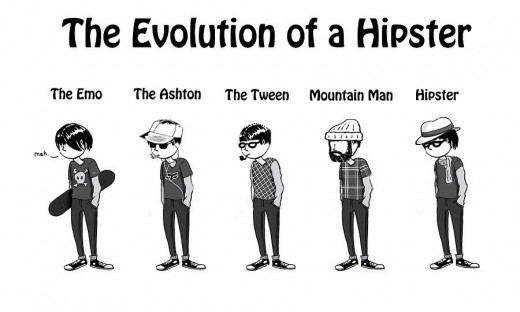
Image result for hipsters suck
<pubscout.com/thepubscout/wp-content/uploads/2013/02/hipster-evolution-brendan-mccartan.jpg>


<i.>
Every musician experiences misadventure. I'm no different. I've weathered my fair shaer of them after My First Band, which probably sounds like Your First Band. 

Take the issue of getting shows, Your First Band's lifeblood. Without them, it's tough to justify all that time spent polishing those nuggets into songs, let alone recording (God forbid), or assembling, a release that somebody might want to buy (God forbid, again). You wouldn't hire a plumber sight unseen, so why buy a record you've never heard, right?

However, unless you're well-connected, getting to play venues that don't treat you like dirt, and pay decently, is next to impossible. I'm as DIY as the next man, but surely, Your First Band benefits from treading a few well-established boards, right? Remember, whether you book the gigs, or someone else does, you face the same challenge: getting people to show up (God forbid, yet again).

Then why's it so hard to score decent shows? Because the venues that matter are often run by a clique that spends much of its time and energy clanking up the drawbridges of their real or imagined castles against those dreaded outsiders. Every local music scene suffers from this syndrome, to varying degrees. Some places are better than others; such is life.

I learned this lesson the hard way, when I tried booking My First Band at Club Snoot. Our guitarist suggested it, because their management worked in tandem with our hometown watering hole, Romanov's (an hour and 70-odd miles south).

"If you're in, you're in," my guitarist prompted. "Bands that play one of those clubs usually play at the other."


<ii.>
Thus encouraged, I dutifully phoned Club Snoot's booker, the bass player and frontman for a hot local prog-metal band. We'll call them Grey Matter Cartel. (Storyteller's Note: Names have been changed to avoid retribution from the guilty. It sucks, but it is what it is.) 

I ran down My First Band's sound and credentials, such as they were, after roughly a year of existence. We seemed to get on okay, until I mentioned our present lineup: my guitarist, and yours truly (bass, lead vocals). "We're between drummers right now," I explained, "so we're getting by with a drum machine. That's how we started, anyway, so it'll do, for now."

Grey Matter Cartel's mainman immediately took issue. In several exhaustive sentences, he claimed that Club Snoot's crowd weren't used to such fripperies, which they might take for self-indulgence on our part.

Hmm, I thought, doesn't bother the industrial music crowd! Ministry, Skinny Puppy, Sisters Of Mercy -- you name it, nary a drummer among 'em, and nobody's ever asked for their money back! Hell, even conventional bands have done it, including Echo & The Bunnymen,  (sparking a rumor that "Echo" referred to the machine, one the band hotly denied using).

I thought the objections were stupid. This being the late '90s, drummers had often become increasingly sidelined by all manner of mechano-beats, which those big hotshot producers found more expedient to use in their increasingly over-arranged, overly polished scheme of things. Time is money and all that, right?


<iii.>
But I never got to explain those subtleties, such as they were, to Grey Matter Cartel's guiding light. The catch in his throat rang loud and clear: get lost. You aren't what I expect. You're dead meat.

He hemmed and hawed a minute longer. Finally he decided: "I'll book you when you have a drummer. Let me know when you do."

Click! There you had it. We didn't have a live human keeping the beat. Ergo, we couldn't be part of rock's holy trinity, its nuclear family, of guitar, bass and drums. That was that.

Club Snoot has long since closed, like so many dysfunctional dens of iniquity. Grey Matter Cartel itself called it a day in 2001. By then, the fellow I'd spoken to had replaced the whole band, with himself as the sole remaining original. So much for tradition, I suppose.

Still, after scouring the Internet, I've found no evidence of him releasing music after the mid-2000s. Aside from a couple of Grey Matter Cartel reunion shows that happened four years ago, he seems to have disappeared from the scene that he once lorded over.

So, while My First Band didn't go on to massive acclaim, neither has this gent, apparently. I'm still working, mostly on my own, which feels way more satisfying than dealing with the egos and excesses of trying to break My First Band. Or Your First Band, for that matter.

Roy Orbison said it best, I believe, and mind you, I'm working from memory. But the quote goes something like this: "Time takes care of a lot of things." That's my solace, and I'll have to take it. --The Reckoner

Monday, April 30, 2018

Punk Rock Art Corner: "Hipster Word Cloud (Takes I+II)"


<"The book behind you 
is the book behind you; 
the book ahead of you 
is the book ahead of you. 

And a success
 can be as difficult 
to survive 
as a failure. 

When you're a success, 
if you believe it, you're finished.">


<"Any real artist 
will never be judged 
in the time of his time
whatever judgment is delivered 
in the time of his time 
cannot be trusted.">


Quotes: 
James Baldwin,
New York Times, 1985

Images/Photos:
The Reckoner

Monday, September 11, 2017

Not Another List Article: How To Fail As A Writer (Rebutted)

<Photo & Artwork: The Reckoner>


First off, the usual full disclosure: as I've said before, I think, I enjoyed The Book Of Lists and The People's Almanac...first, as a pre-teen, and then, as a high school student, curious about the world around me. In lesser hands, though, the concept underwhelms, which is how I feel about endeavors like one that caught my eye on Bookbaby.com recently: “How To Fail As A Writer.” 

So, in the spirit of providing counter-information, our rebuttals follow below, one mind-numbing trope at a time:

1. Don’t worry too much about your opening line. Readers will soon be past it and into the good stuff.

Fair enough, but maybe the author prefers to ease us into the story. Consider Maj  Sjowall's and Per Wahloo's seventh entry in the Martin Beck mystery series, The Abominable Man (1971). The first chapter simply describes the killer's late night drive through Stockholm, to reach his target – whom he slaughters at the hospital, with a bayonet, in the next chapter. In just eight pages, we've gone from mundane to terrifying. This approach works well, in the right hands. 

2. Don’t be concerned that your ending goes off with a fizzle. The rest of the book was worth the price of admission.

Same response as #1. Sure, sizzle trumps fizzle, but one person's “fizzle” is another person's subtle coda. For further reference, see how The Abominable Man ends:

"Bohlin too climbed up on the roof and looked around.


"'For Christ's sake, why didn't you shoot?' he said. 'I don't get it --'"

"'No one expects you to,' Gunvald Larrson interrupted him. 'By the way, have you got a license for that pistol?'

"Bohlin shook his head.

"'In that case you're probably in trouble,' said Gunvald Larrson. 'Now, come on, let's carry him down.'"

3. Don’t worry about typos and grammatical errors. Trivial details won’t bother veteran readers.

Again, depends on a) your audience, b) intent, and c) underlying rationale. Sniffin' Glue, which launched the whole punk fanzine movement, is riddled with errors, large and small...but we're still reading it and talking about it today. If you're not doing Sniffin' Glue, then, yeah, get a proofreader.

4. Go with your first complete draft as your final draft. Your gut instincts were correct the first time around, you’ll just dilute them when you edit.

Didn't hurt Allen Ginsberg, William Burroughs or Jack Kerouac, right? Whose ghosts would you hang out with in that After Life Waiting Room – the above gents, or the editor of Lawnmower Quarterly, who's sweating over every comma till his hands bleed? 'Nuff said!

5. Only write when the urge hits you. If you need discipline to write, it’s not really writing.

Many big name authors, like Stephen King, make a point of writing so-and-so many words a day, regardless, because it's a discipline, some sort of a job, blah-blah-blah...doesn't work for me at all. I'm not the type who waits all day for inspiration, but let's face it – I got into writing, and other creative activities, in hopes of escaping the nine-to-five (plus) job. The day I approach it that way is the day I think about doing something else.

6. Do not exercise, enjoy hobbies, or have any kind of life . Any minute spent not writing is time down the drain.

Some people thrive on battering till the job gets done. If that means locking themselves away from friends, TV or Internet, why should we care, if the results kick ass? Leave 'em alone, and leave 'em to it!

7. Sleep as little as possible. Sleep deprivation will unlock your inner writing god.

Maybe, maybe not. No two writers' circadian rhythms run alike. For reference, I only need to look at my household. I'm a dedicated night owl, who's lived much of his life between “midnight to six,” as the Pretty Things say. By contrast, Squawker is more of a day person, and would probably wilt trying to keep my hours. In other words: to each his own.


<Failure is not an option.>

8. Quit your day job immediately. Work gets in the way of your writing.

I can only speak for myself here. When you're doing that 40-hour drill, as I once did, time is the rarest element on your personal periodic table. Not surprisingly, you often feel squeezed, even resentful, of having to divide your creative energies with The Man's demands and expectations. On the plus side, you're less likely to waste time, because every minute counts (literally).

Now, after a decade of self-employment, the creative ball game has changed. I feel more relaxed, after doing my “rent money party” stuff – those un-sexy, greenback-generating activities that you need to pay the freight – I have more freedom to pursue creative activities that often got diverted, postponed, or sidetracked, depending on whatever juggling I was doing that week between my day job, household demands, and personal life.

So it's not a case of, "Is one schedule better than another?" A better question might be, "Here's Door Number 1. Here's Door Number 2. Both carry big tradeoffs. Which ones can you live with, depending on which door swings open?"

9. Be as original as possible, forget conforming to any genre expectations.

Should every writer resign themselves to cranking out genre fodder? Some of the biggest splashes – books, film, or TV, take your pick – have come from defying the expectations that straitjacket the best-laid genre fiction. Imagine a tone-deaf executive's reaction to Vince Gilligan's famed pitch for “Breaking Bad”: “You're gonna turn a mild-mannered high school chemistry teacher into 'Mr.Chips'? Are you kidding me? The teacher's unions will crucify us!” Thankfully, it didn't happen that way.

10. Ignore the belief that publishable books have structure or that you need one.

Didn't stop anyone from reading Naked Lunch, or On The Road, right? To name only two famous works that break this rule.

11. Leave details as ambiguous as you can. Let your readers rely on their mind-reading abilities to intuit what you really meant .

Ambiguity is a powerful tool, actually. Haiku is rife with it. Russian literature couldn't exist without it. Scandinavian crime fiction extensively integrates it into the plotlines (such as in our above example, The Abominable Man, whose victim turns out to have been one brutal SOB in uniform, once Beck and his colleagues dig deeper). A pox on such commandments!

12. Make sure your readers cannot easily form mental images from your story.

Overdosing on imagery and exposition is equally bad. I remember a high school teacher saying how much he loved James Michener, with one caveat – at times, he found himself wishing for a bit less detail: “I love him, but sometimes, I find myself asking, 'When he's gonna get done?'”

13. Don’t worry about logical inconsistencies, keep your readers on their toes!

Like so many aspects of writing, inconsistency depends on who defines it – but it's not necessarily a show stopper, as any child of the '60s and '70s can tell you, particularly when you consider how network TV worked then. 

Consider “Batman”'s infamous third (and final) season. It's a season where the Penguin doesn't seem to recognize Alfred, the loyal butler, despite their many previous run-ins; Batman seems unable to suss out Batgirl's secret identity, even after spending time with her under their respective civilian alter egos (Bruce Wayne, Barbara Gordon); and strange, second-tier villains like the hyper-feminist menace, Nora Clavicle, flout their own conventions by dressing in slinky, sexy outfits (that men, presumably, might find appealing -- instead of the Margaret Thatcher prison matron's garb you'd expect her to wear, right?).

In short, the scriptwriters tossed consistency out the window totally, after a stellar first season, and a reasonably solid second one (despite a handful of clunkers). Even so, for all the above howlers, they're part of our pop cultural memory bank, and they've never stopped airing (consistent or not).

14. Do not waste time learning the craft of writing. Focus on producing lots of words – that’s what writing is all about.

Of course, it's worth remembering that, once upon a time, producing lots of words is exactly what writers did, because that's how they got paid. Pulp-era titans like Edgar Rice Burroughs and Zane Grey earned, on average, five to 10 cents a word, or $3,000-4,000 per novel produced. Even so, disparities persisted, as Burroughs famously groused about his rival: "Zane Grey, the only writer who probably tops my sales, owns yachts and beautiful summer homes ... he cruises all over the world, while I sit here with my nose to the grindstone."

The point is that, in this scenario, craft took second priority to simpler considerations (like selling) -- although Burroughs tried, in vain, to crack the slick magazines, without success. He saw himself as a populist entertainer and storyteller first, as he explained his decision to start writing at 35, after many failed business ventures ("I made up my mind that if people were paid for writing such rot as I read, I could write stories just as rotten").

Those issues are no less apparent today. How artful does a Harlequin romance novelist really need to be, for example, given the formula they're expected to follow? Which isn't to suggest you should give up, or give in, because writing is a craft. Just realize, that in certain situations, you may have to make some allowances. 


<Failure is not an option.>

15. Don’t read, not even the great authors. And especially never read other authors in your genre . Their writing might rub off on you and make yours less original.

Here's the flipside of that argument. I've seen many aspiring writers soak up favored influences, to their detriment. How else to explain the countless Charles Bukowski wannabes that I endured at college literary readings, as they tripped over one another in recreating his style, while exploring the seamier side of East Lansing's happy hour bars, sweater-clad armies of preps, and split-level aluminum siding. None of them, of course, had ever experienced a county hospital ward, a drunk tank or racetrack. Net result? I stopped reading Bukowski for quite awhile. 

16. Do not research your topic. Your intuition is more compelling than facts.

If you're writing a historical period piece, that's one thing. If you're interweaving bits of life experience with anecdotes, journal entries, and news articles – that's a different kettle of piranha, as they say in England. A story or a novel is more than just an array of facts, no matter how artfully arranged.

17. Do not ever read for other writers. Critiquing will just cloud your mind and take your focus off your own work.

Skip to Statements #22 and #23.

18. If an editor critiques your writing, stick to your guns that it’s his fault he didn’t understand “what you really meant.”

Most editors' suggestions, in my experience, will raise your game. That only makes the boneheads stand out more, such as the one who change a quote of mine, about a rock guitarist who questioned his manager's agenda. The quote changed from, "He sussed him out, good and proper," to, "He cussed him out, good and proper." Apparently, the guy had no grip on the subtleties of British slang, but did he ask me? I didn't find out till the back issues hit my PO box. Yes, I went ballistic, but I couldn't fix the damage after the fact. Every time I see that quote, I get irritated all over again. Trust me: sometimes, it's best to stand your ground.

19. If a reader gives you feedback that something in the plot seems to be missing, ignore her. Better yet, prove it’s “all there” by pointing to page 224, where three words in the middle of a paragraph at the end of the chapter “explain it all.”

Like editors, readers can help by pointing out things you've missed, or call attention to issues that might slip past you. Or, as I've seen on many a Goodreads site, or forum – they can also bang on endlessly about minor points, dredge up irrelevancies that don't matter, or miss the point you're trying to drive home.

20. Never back up the electronic copy of your work. It’s good for your creative juices to be in constant fear of losing your book beyond the event horizon of the cyber black hole.

Now this statement actually makes sense! But you can't force people to back up their data. Nor is it a new issue, as I remember from seeing people in journalism classes rush to share their latest scoop, and snap on the tape recorder, only to watch their faces sag when you heard: "Fzzzzzzzz....

 The “I've Gotten Away With It So Far” Club is stuffed with too many charter members who left their creations in the laps of the digital gods – and suffered accordingly. It's one reason why I write out a lot of my stuff in longhand first, or even dictate it into a digital voice recorder. Different strokes, different folks, and all that.

21. Forget the idea of practicing any kind of writing other than your book. It’s just a distraction.

Didn't hurt J.D. Salinger, did it? As he famously noted about his best-known work, The Catcher In The Rye, he claimed to have spent 30 years – essentially, whatever life he'd lived, up till then – in preparing to write it. As I've aleady noted, some people thrive on that kind of single-mindedness.


<Failure is not an option.>

22. Do not stoop so low as to take the advice of writers who have walked the path before you. You need to find your own path in your own way.

23. Never show your writing to anyone.

These last two statements mirror each other, so I'll tackle them together. Generally speaking, you will have to figure out your own path, because you may encounter people who try steering you in their direction -- whether it makes sense, or doesn't -- or fail to understand what you're doing.

Getting feedback is a good idea. Just remember, though, it's not always infallible. Take the oft-told story of Van Halen's producer, Ted Templeman, goading Eddie Van Halen, into re-recording one of his guitar solos...again. And again. And again.. Finally, after many frustrating, fruitless hours, Eddie went into the studio alone, late at night, and recorded the solo he felt like doing. But he didn't breathe a word to anybody. The next day, Templeman heard the results, and -- so the story goes -- said: “Great!” Don't feel surprised if this happens to you once or twice in your travels.

Let's face it – allowing list articles to guide your creative destiny is like asking your friendly neighborhood fortune teller if that job offer (Chief Rat Killer) is the one that you've really wanted all your life. Except the fortune teller's batting average might end up a tad higher than the list article. --The Reckoner


<Photo & Artwork: The Recokner>


Links To Go (Hurry, Before 
Somebody Writes Another Damned List Article):
Bookbaby: How To Fail As A Writer:
http://blog.bookbaby.com/2016/09/how-to-fail-as-a-writer/?utm_campaign=BB1723&utm_source=BBeNews&utm_medium=Email&spMailingID=54221551&spUserID=MjIyOTk2MTAzNDE3S0&spJobID=1181011978&spReportId=MTE4MTAxMTk3OAS2


Odyssey: A List Article
About Why I Hate List Articles:
https://www.theodysseyonline.com/list-article-hate-list-articles

The Daily Telegraph: 
Xenophobic Hack Or Master Storyteller?:
http://www.telegraph.co.uk/films/2016/07/06/xenophic-hack-or-master-storyteller-the-wild-world-of-edgar-rice