Showing posts with label art cliques suck. Show all posts

Tuesday, December 31, 2019

Windy City Snapshot: The Article That Never Ran


<And an anti-New Year to you, too...
I drew this graphic at 15,
May 1979, when stuff like
Lou Reed and the Velvet Underground
formed essential building blocks
of my high school soundtrack.
It fits the vibe here, I think.>

<"I mastered the art of recording 
known as 'capture the spontaneous moment 
and leave it at that'. The Bells was done like that, 
those lyrics were just made up on the spot 
and they're absolutely incredible.>

<"I'm very adept at making up 
whole stories with rhymes, schemes, jokes."
Lou Reed, CREEM, September 1980
("Lou Reed Tilts The Machine">


Reckoner's Note: During my Windy City era, I kept busy freelancing for all sorts of national music rags, from the technical (Guitar Player) to the retro (Goldmine), to the general (coffee table reference guides that needed lots and lots of entries, like, yesterday, man). When that era started, I also figured it would make sense to try and get some local action, too, in case the national stuff dried up.

Alas, though, it didn't work out that way, as the following piece might indicate. I wrote it back in 1996-97, but it's never seen the light of day -- until now. This era coincided with the rise of alternative weeklies, who prided themselves on cranking out stories that The Man (as in, mainstream media) either forgot about, or flat out ignored. This was the place to start, if I wanted to do any local freelancing. Or so I was told.

I approached several outlets, but the one mentioned below (City Vibes) was the only rag to respond. Or not respond, which is what I ended up writing about, to salvage the situation -- this piece came during an era when I paid 30 cents a shot, even for local calls! 

But none of these issues satisfied the folks at City Vibes, who refused to pay. I didn't expect the full shot, by any means, but I felt my time deserved something. After all, major mags pay "kill fees" all the time, on stories that don't run, for just that reason. But not in the Windy City, apparently. I said something like, "Go fly a kite," and I never approached any of the alt-poobahs again. I  kept doing my national stuff, and never looked back, as the saying goes. 

Of course, the bloom has long fallen off the alternative weekly rose, as you'll see from the links below. But I refuse to join the Viking funeral, not only because their time has come, and gone -- and more outlets have sprung up to replace them -- but from a simple truth.

If you don't feel like answering the phone, or paying for my time, don't expect me to wear out my lips kissing you all goodbye. 
The piece follows below. As usual, all the names have been changed, to avoid retribution from the guilty. Make of it what you will. --The Reckoner


THE VILLAGE PEOPLE PUNK OUT (AND I GET TO HOLD THE CHECK)
I only wanted the just the facts, but all I got were just the flacks. So it went when City Vibes deputized me to buttonhole those notorious '70s bad taste icons, The Village People, currently headlining an all-star disco demolition over The Trammps ("Disco Inferno"), and KC & The Sunshine Band ("Boogie Shoes," "Shake Your Booty," and too many others to mention), on March 29 (Star Plaza Theater, Merrillvile, IN), and March 30 (The Rosemont, Chicago).

"No problem," Star Plaza's Marketing Maven reassured me, in late February. "I'll pass on your request to the Village People, and they'll call you." The mind boggles. At last, I get to pop choice nuggets, like, "And when did The Cop take a hike?" Three weeks dribbled away: no Village People, no response. Maybe they'd misplaced their Rolodex?

Take two, Monday, March 15. "I've called, but there's no answer," the Marketing Maven assures me. "Well, my girlfriend's usually here, if I'm not," respond. A length pause follows: "Oh." 

Take three, Friday, March 19: I get A) Star Plaza directions, B) travel/ticket information, C) a plug for group discounts, and oh, yes, the Marketing Maven's voicemail. But she's not there.

Take four, that same Friday: I left a message with the Rosemont's PR flacks, figuring the locals might cooperate more. No such luck, though. I guess they don't need to return my call, let alone risk the publicity.

What a unique response -- this from a group who hammered three chart grand slams in "Macho Man" ($25, 1978), "YMCA" (#1, 1979; two million US, 12 million worldwide sales); and "In The Navy" (#3, 1979), before bottoming out with "Go West" (#45, 1979), and "Ready For The '80s" (#52, three weeks, 1/80). 

Maybe "The Peeps," as many reviewers affectionately tagged them, want us to forget such milestones as their double-LP, Live & Sleazy, or Can't Stop The Music, possibly America's only pro-disco musical, starring Nancy Walker.

Of the original Peeps, lead singer Victor Willis (The Cop), and Randy Jones (The Cowboy), have since left the group, whose fearsomely-styled costuming (including a biker, GI and Indian, among others), and cartoonish bump 'n' grind remain a pleasant night out, primarily on college campuses. If you go, expect no surprises.

One last tidbit: The Wacky Top 40 (1993) now contains a corrective statement for anyone accusing the Peeps of nasty Milli Vanilli-style live lip sync: "The Village People have responded uniformly to such rumors by making it clear that they sang live in all their concert settings for the last 17 years."

Feel better? I hope so, and for those who doubt me, The Star Plaza and the Rosemont  do have the finest voicemail systems I've ever encountered. Too bad they don't talk back.

Links To Go (Hurry, Hurry,

Your Favorite Alt-Weekly's Hit The Funeral Pyre):

CityLab: Making Peace
With The Decline Of Alt-Weeklies:
https://www.citylab.com/equity/2013/03/making-peace-decline-alt-weeklies/5043/

Governing.com:
Mourning The Decline Of Alt-Weeklies:
https://www.governing.com/topics/politics/gov-local-news-alt-weeklies-watchdogs.html

Reuters:
The Long, Slow Decline Of Alt-Weeklies:
http://blogs.reuters.com/jackshafer/2013/03/15/the-long-slow-decline-of-alt-weeklies/

Tuesday, May 29, 2018

Life's Little Injustices (Take XIII): No Drummer? No Booking


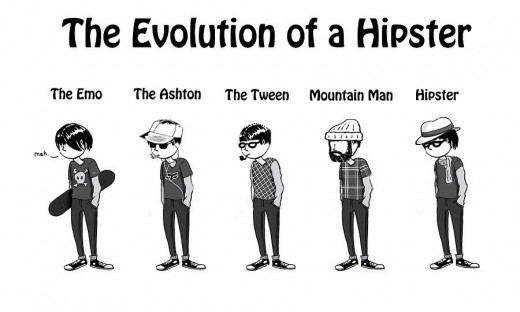
Image result for hipsters suck
<pubscout.com/thepubscout/wp-content/uploads/2013/02/hipster-evolution-brendan-mccartan.jpg>


<i.>
Every musician experiences misadventure. I'm no different. I've weathered my fair shaer of them after My First Band, which probably sounds like Your First Band. 

Take the issue of getting shows, Your First Band's lifeblood. Without them, it's tough to justify all that time spent polishing those nuggets into songs, let alone recording (God forbid), or assembling, a release that somebody might want to buy (God forbid, again). You wouldn't hire a plumber sight unseen, so why buy a record you've never heard, right?

However, unless you're well-connected, getting to play venues that don't treat you like dirt, and pay decently, is next to impossible. I'm as DIY as the next man, but surely, Your First Band benefits from treading a few well-established boards, right? Remember, whether you book the gigs, or someone else does, you face the same challenge: getting people to show up (God forbid, yet again).

Then why's it so hard to score decent shows? Because the venues that matter are often run by a clique that spends much of its time and energy clanking up the drawbridges of their real or imagined castles against those dreaded outsiders. Every local music scene suffers from this syndrome, to varying degrees. Some places are better than others; such is life.

I learned this lesson the hard way, when I tried booking My First Band at Club Snoot. Our guitarist suggested it, because their management worked in tandem with our hometown watering hole, Romanov's (an hour and 70-odd miles south).

"If you're in, you're in," my guitarist prompted. "Bands that play one of those clubs usually play at the other."


<ii.>
Thus encouraged, I dutifully phoned Club Snoot's booker, the bass player and frontman for a hot local prog-metal band. We'll call them Grey Matter Cartel. (Storyteller's Note: Names have been changed to avoid retribution from the guilty. It sucks, but it is what it is.) 

I ran down My First Band's sound and credentials, such as they were, after roughly a year of existence. We seemed to get on okay, until I mentioned our present lineup: my guitarist, and yours truly (bass, lead vocals). "We're between drummers right now," I explained, "so we're getting by with a drum machine. That's how we started, anyway, so it'll do, for now."

Grey Matter Cartel's mainman immediately took issue. In several exhaustive sentences, he claimed that Club Snoot's crowd weren't used to such fripperies, which they might take for self-indulgence on our part.

Hmm, I thought, doesn't bother the industrial music crowd! Ministry, Skinny Puppy, Sisters Of Mercy -- you name it, nary a drummer among 'em, and nobody's ever asked for their money back! Hell, even conventional bands have done it, including Echo & The Bunnymen,  (sparking a rumor that "Echo" referred to the machine, one the band hotly denied using).

I thought the objections were stupid. This being the late '90s, drummers had often become increasingly sidelined by all manner of mechano-beats, which those big hotshot producers found more expedient to use in their increasingly over-arranged, overly polished scheme of things. Time is money and all that, right?


<iii.>
But I never got to explain those subtleties, such as they were, to Grey Matter Cartel's guiding light. The catch in his throat rang loud and clear: get lost. You aren't what I expect. You're dead meat.

He hemmed and hawed a minute longer. Finally he decided: "I'll book you when you have a drummer. Let me know when you do."

Click! There you had it. We didn't have a live human keeping the beat. Ergo, we couldn't be part of rock's holy trinity, its nuclear family, of guitar, bass and drums. That was that.

Club Snoot has long since closed, like so many dysfunctional dens of iniquity. Grey Matter Cartel itself called it a day in 2001. By then, the fellow I'd spoken to had replaced the whole band, with himself as the sole remaining original. So much for tradition, I suppose.

Still, after scouring the Internet, I've found no evidence of him releasing music after the mid-2000s. Aside from a couple of Grey Matter Cartel reunion shows that happened four years ago, he seems to have disappeared from the scene that he once lorded over.

So, while My First Band didn't go on to massive acclaim, neither has this gent, apparently. I'm still working, mostly on my own, which feels way more satisfying than dealing with the egos and excesses of trying to break My First Band. Or Your First Band, for that matter.

Roy Orbison said it best, I believe, and mind you, I'm working from memory. But the quote goes something like this: "Time takes care of a lot of things." That's my solace, and I'll have to take it. --The Reckoner

Monday, September 11, 2017

Not Another List Article: How To Fail As A Writer (Rebutted)

<Photo & Artwork: The Reckoner>


First off, the usual full disclosure: as I've said before, I think, I enjoyed The Book Of Lists and The People's Almanac...first, as a pre-teen, and then, as a high school student, curious about the world around me. In lesser hands, though, the concept underwhelms, which is how I feel about endeavors like one that caught my eye on Bookbaby.com recently: “How To Fail As A Writer.” 

So, in the spirit of providing counter-information, our rebuttals follow below, one mind-numbing trope at a time:

1. Don’t worry too much about your opening line. Readers will soon be past it and into the good stuff.

Fair enough, but maybe the author prefers to ease us into the story. Consider Maj  Sjowall's and Per Wahloo's seventh entry in the Martin Beck mystery series, The Abominable Man (1971). The first chapter simply describes the killer's late night drive through Stockholm, to reach his target – whom he slaughters at the hospital, with a bayonet, in the next chapter. In just eight pages, we've gone from mundane to terrifying. This approach works well, in the right hands. 

2. Don’t be concerned that your ending goes off with a fizzle. The rest of the book was worth the price of admission.

Same response as #1. Sure, sizzle trumps fizzle, but one person's “fizzle” is another person's subtle coda. For further reference, see how The Abominable Man ends:

"Bohlin too climbed up on the roof and looked around.


"'For Christ's sake, why didn't you shoot?' he said. 'I don't get it --'"

"'No one expects you to,' Gunvald Larrson interrupted him. 'By the way, have you got a license for that pistol?'

"Bohlin shook his head.

"'In that case you're probably in trouble,' said Gunvald Larrson. 'Now, come on, let's carry him down.'"

3. Don’t worry about typos and grammatical errors. Trivial details won’t bother veteran readers.

Again, depends on a) your audience, b) intent, and c) underlying rationale. Sniffin' Glue, which launched the whole punk fanzine movement, is riddled with errors, large and small...but we're still reading it and talking about it today. If you're not doing Sniffin' Glue, then, yeah, get a proofreader.

4. Go with your first complete draft as your final draft. Your gut instincts were correct the first time around, you’ll just dilute them when you edit.

Didn't hurt Allen Ginsberg, William Burroughs or Jack Kerouac, right? Whose ghosts would you hang out with in that After Life Waiting Room – the above gents, or the editor of Lawnmower Quarterly, who's sweating over every comma till his hands bleed? 'Nuff said!

5. Only write when the urge hits you. If you need discipline to write, it’s not really writing.

Many big name authors, like Stephen King, make a point of writing so-and-so many words a day, regardless, because it's a discipline, some sort of a job, blah-blah-blah...doesn't work for me at all. I'm not the type who waits all day for inspiration, but let's face it – I got into writing, and other creative activities, in hopes of escaping the nine-to-five (plus) job. The day I approach it that way is the day I think about doing something else.

6. Do not exercise, enjoy hobbies, or have any kind of life . Any minute spent not writing is time down the drain.

Some people thrive on battering till the job gets done. If that means locking themselves away from friends, TV or Internet, why should we care, if the results kick ass? Leave 'em alone, and leave 'em to it!

7. Sleep as little as possible. Sleep deprivation will unlock your inner writing god.

Maybe, maybe not. No two writers' circadian rhythms run alike. For reference, I only need to look at my household. I'm a dedicated night owl, who's lived much of his life between “midnight to six,” as the Pretty Things say. By contrast, Squawker is more of a day person, and would probably wilt trying to keep my hours. In other words: to each his own.


<Failure is not an option.>

8. Quit your day job immediately. Work gets in the way of your writing.

I can only speak for myself here. When you're doing that 40-hour drill, as I once did, time is the rarest element on your personal periodic table. Not surprisingly, you often feel squeezed, even resentful, of having to divide your creative energies with The Man's demands and expectations. On the plus side, you're less likely to waste time, because every minute counts (literally).

Now, after a decade of self-employment, the creative ball game has changed. I feel more relaxed, after doing my “rent money party” stuff – those un-sexy, greenback-generating activities that you need to pay the freight – I have more freedom to pursue creative activities that often got diverted, postponed, or sidetracked, depending on whatever juggling I was doing that week between my day job, household demands, and personal life.

So it's not a case of, "Is one schedule better than another?" A better question might be, "Here's Door Number 1. Here's Door Number 2. Both carry big tradeoffs. Which ones can you live with, depending on which door swings open?"

9. Be as original as possible, forget conforming to any genre expectations.

Should every writer resign themselves to cranking out genre fodder? Some of the biggest splashes – books, film, or TV, take your pick – have come from defying the expectations that straitjacket the best-laid genre fiction. Imagine a tone-deaf executive's reaction to Vince Gilligan's famed pitch for “Breaking Bad”: “You're gonna turn a mild-mannered high school chemistry teacher into 'Mr.Chips'? Are you kidding me? The teacher's unions will crucify us!” Thankfully, it didn't happen that way.

10. Ignore the belief that publishable books have structure or that you need one.

Didn't stop anyone from reading Naked Lunch, or On The Road, right? To name only two famous works that break this rule.

11. Leave details as ambiguous as you can. Let your readers rely on their mind-reading abilities to intuit what you really meant .

Ambiguity is a powerful tool, actually. Haiku is rife with it. Russian literature couldn't exist without it. Scandinavian crime fiction extensively integrates it into the plotlines (such as in our above example, The Abominable Man, whose victim turns out to have been one brutal SOB in uniform, once Beck and his colleagues dig deeper). A pox on such commandments!

12. Make sure your readers cannot easily form mental images from your story.

Overdosing on imagery and exposition is equally bad. I remember a high school teacher saying how much he loved James Michener, with one caveat – at times, he found himself wishing for a bit less detail: “I love him, but sometimes, I find myself asking, 'When he's gonna get done?'”

13. Don’t worry about logical inconsistencies, keep your readers on their toes!

Like so many aspects of writing, inconsistency depends on who defines it – but it's not necessarily a show stopper, as any child of the '60s and '70s can tell you, particularly when you consider how network TV worked then. 

Consider “Batman”'s infamous third (and final) season. It's a season where the Penguin doesn't seem to recognize Alfred, the loyal butler, despite their many previous run-ins; Batman seems unable to suss out Batgirl's secret identity, even after spending time with her under their respective civilian alter egos (Bruce Wayne, Barbara Gordon); and strange, second-tier villains like the hyper-feminist menace, Nora Clavicle, flout their own conventions by dressing in slinky, sexy outfits (that men, presumably, might find appealing -- instead of the Margaret Thatcher prison matron's garb you'd expect her to wear, right?).

In short, the scriptwriters tossed consistency out the window totally, after a stellar first season, and a reasonably solid second one (despite a handful of clunkers). Even so, for all the above howlers, they're part of our pop cultural memory bank, and they've never stopped airing (consistent or not).

14. Do not waste time learning the craft of writing. Focus on producing lots of words – that’s what writing is all about.

Of course, it's worth remembering that, once upon a time, producing lots of words is exactly what writers did, because that's how they got paid. Pulp-era titans like Edgar Rice Burroughs and Zane Grey earned, on average, five to 10 cents a word, or $3,000-4,000 per novel produced. Even so, disparities persisted, as Burroughs famously groused about his rival: "Zane Grey, the only writer who probably tops my sales, owns yachts and beautiful summer homes ... he cruises all over the world, while I sit here with my nose to the grindstone."

The point is that, in this scenario, craft took second priority to simpler considerations (like selling) -- although Burroughs tried, in vain, to crack the slick magazines, without success. He saw himself as a populist entertainer and storyteller first, as he explained his decision to start writing at 35, after many failed business ventures ("I made up my mind that if people were paid for writing such rot as I read, I could write stories just as rotten").

Those issues are no less apparent today. How artful does a Harlequin romance novelist really need to be, for example, given the formula they're expected to follow? Which isn't to suggest you should give up, or give in, because writing is a craft. Just realize, that in certain situations, you may have to make some allowances. 


<Failure is not an option.>

15. Don’t read, not even the great authors. And especially never read other authors in your genre . Their writing might rub off on you and make yours less original.

Here's the flipside of that argument. I've seen many aspiring writers soak up favored influences, to their detriment. How else to explain the countless Charles Bukowski wannabes that I endured at college literary readings, as they tripped over one another in recreating his style, while exploring the seamier side of East Lansing's happy hour bars, sweater-clad armies of preps, and split-level aluminum siding. None of them, of course, had ever experienced a county hospital ward, a drunk tank or racetrack. Net result? I stopped reading Bukowski for quite awhile. 

16. Do not research your topic. Your intuition is more compelling than facts.

If you're writing a historical period piece, that's one thing. If you're interweaving bits of life experience with anecdotes, journal entries, and news articles – that's a different kettle of piranha, as they say in England. A story or a novel is more than just an array of facts, no matter how artfully arranged.

17. Do not ever read for other writers. Critiquing will just cloud your mind and take your focus off your own work.

Skip to Statements #22 and #23.

18. If an editor critiques your writing, stick to your guns that it’s his fault he didn’t understand “what you really meant.”

Most editors' suggestions, in my experience, will raise your game. That only makes the boneheads stand out more, such as the one who change a quote of mine, about a rock guitarist who questioned his manager's agenda. The quote changed from, "He sussed him out, good and proper," to, "He cussed him out, good and proper." Apparently, the guy had no grip on the subtleties of British slang, but did he ask me? I didn't find out till the back issues hit my PO box. Yes, I went ballistic, but I couldn't fix the damage after the fact. Every time I see that quote, I get irritated all over again. Trust me: sometimes, it's best to stand your ground.

19. If a reader gives you feedback that something in the plot seems to be missing, ignore her. Better yet, prove it’s “all there” by pointing to page 224, where three words in the middle of a paragraph at the end of the chapter “explain it all.”

Like editors, readers can help by pointing out things you've missed, or call attention to issues that might slip past you. Or, as I've seen on many a Goodreads site, or forum – they can also bang on endlessly about minor points, dredge up irrelevancies that don't matter, or miss the point you're trying to drive home.

20. Never back up the electronic copy of your work. It’s good for your creative juices to be in constant fear of losing your book beyond the event horizon of the cyber black hole.

Now this statement actually makes sense! But you can't force people to back up their data. Nor is it a new issue, as I remember from seeing people in journalism classes rush to share their latest scoop, and snap on the tape recorder, only to watch their faces sag when you heard: "Fzzzzzzzz....

 The “I've Gotten Away With It So Far” Club is stuffed with too many charter members who left their creations in the laps of the digital gods – and suffered accordingly. It's one reason why I write out a lot of my stuff in longhand first, or even dictate it into a digital voice recorder. Different strokes, different folks, and all that.

21. Forget the idea of practicing any kind of writing other than your book. It’s just a distraction.

Didn't hurt J.D. Salinger, did it? As he famously noted about his best-known work, The Catcher In The Rye, he claimed to have spent 30 years – essentially, whatever life he'd lived, up till then – in preparing to write it. As I've aleady noted, some people thrive on that kind of single-mindedness.


<Failure is not an option.>

22. Do not stoop so low as to take the advice of writers who have walked the path before you. You need to find your own path in your own way.

23. Never show your writing to anyone.

These last two statements mirror each other, so I'll tackle them together. Generally speaking, you will have to figure out your own path, because you may encounter people who try steering you in their direction -- whether it makes sense, or doesn't -- or fail to understand what you're doing.

Getting feedback is a good idea. Just remember, though, it's not always infallible. Take the oft-told story of Van Halen's producer, Ted Templeman, goading Eddie Van Halen, into re-recording one of his guitar solos...again. And again. And again.. Finally, after many frustrating, fruitless hours, Eddie went into the studio alone, late at night, and recorded the solo he felt like doing. But he didn't breathe a word to anybody. The next day, Templeman heard the results, and -- so the story goes -- said: “Great!” Don't feel surprised if this happens to you once or twice in your travels.

Let's face it – allowing list articles to guide your creative destiny is like asking your friendly neighborhood fortune teller if that job offer (Chief Rat Killer) is the one that you've really wanted all your life. Except the fortune teller's batting average might end up a tad higher than the list article. --The Reckoner


<Photo & Artwork: The Recokner>


Links To Go (Hurry, Before 
Somebody Writes Another Damned List Article):
Bookbaby: How To Fail As A Writer:
http://blog.bookbaby.com/2016/09/how-to-fail-as-a-writer/?utm_campaign=BB1723&utm_source=BBeNews&utm_medium=Email&spMailingID=54221551&spUserID=MjIyOTk2MTAzNDE3S0&spJobID=1181011978&spReportId=MTE4MTAxMTk3OAS2


Odyssey: A List Article
About Why I Hate List Articles:
https://www.theodysseyonline.com/list-article-hate-list-articles

The Daily Telegraph: 
Xenophobic Hack Or Master Storyteller?:
http://www.telegraph.co.uk/films/2016/07/06/xenophic-hack-or-master-storyteller-the-wild-world-of-edgar-rice

Friday, April 28, 2017

Taylor Swift Sleeps In Satan's Pocket (So Satisfy Your Artistic Soul Anyway, OK?)

<http://www.teen.com/2013/07/09/news/taylor-swift-satan-sign-holder-arrested/>

<When the mimes are heading for the exits, they're trying to tell you something: Taylor Swift ponders her country-pop confections' impacts on a generation...and shudders>

<i.>
One of the more amusing conspiracy theories making the rounds is the notion that country-pop phenom Taylor Swift is a) a former Satanic cult leader, b) a clone of '90s-era Satanist Zeena LaVey (as in, daughter of the late Anton LaVey, Church of Satan founder), or c) involved in some other unspeakable fashion with "THE PLACE WHERE THE GUY WITH THE HORNS AND THE POINTED STICK CONDUCTS HIS BUSINESS" (to quote Frank Zappa's "warning label" for his 1985 album, Frank Zappa Meets The Mothers Of Prevention).

You know what? I think the theorists are onto something. 

Surely, there's something Satanic about the Orwellian pervasiveness that carpet-bombs Swift's country-pop confections so remorselessly down our throats, everywhere we go. Like so many hyper-commercial phenomenons, she's absurdly overexposed, a situation hardly mitigated by her habit of slapping cease and desist orders on anything that moves or breathes without her approval. And future pop archaeologists will have loads of fun deciphering all those in-joke-laden odes to her exes (that'll require reams of footnotes to enlighten the next generation, if -- and when -- they're due for a reissue.)

But that's not how Discmakers' sees it. From their standpoint, I'm doing it wrong, at least, when it comes to programming my YouTube channel. Instead of posting what excites me on some level, I need to buckle down, and start covering more current artists, like Swift. Charting any other course is simply "flawed and self-indulgent," as Discmakers columnist Johnny Dwinnell suggests:

"You put up videos of your original material, but no one in the marketplace is aware of you, so you get zero views from new possible fans; just views from friends and family.

"You make videos of you covering your favorite obscure songs, but again, the only views you get are from people who already know you because nobody is searching for the original version of the curiosity you decided to cover in the quest to satisfy your artist soul."


"I'm An Artist-Businessman..."

<ii.>
What's the answer? Don't worry, Dr. Dwinnell has the cure: "This is where the cathartic artistic satisfaction comes from, putting your stamp on another artist’s original song. The more distant the original artist’s style is from yours, the more compelling your version can be. Take artistic license and go as crazy as you want to." To be fair, he doesn't suggest focusing on Swiftl full-time, since "every girl and her mother are posting their version of the latest Taylor Swift single."

On its face, such logic is sound enough. Consider how the Clash so indelibly stamped their full throttle punk attack on Junior Marvin's seminal cry of protest, "Police & Thieves." Released in May 1976, the song traveled well beyond its Jamaican origins -- notably, to the Notting HIll Carnival, in London, where it became an anthem for residents who battled a heavy-handed police presence there on August 30, 1976.


Two of the participants, Clash members Joe Strummer and Paul Simonon, decided to record "Police & Thieves." (The experience also reportedly inspired the first major Clash anthem, "White Riot."). The
 main ingredients -- Strummer's passionate vocal performance, Mick Jones's deft arranging, and unrelenting rhythmic attack -- ensured a permanent slot for "Police & Thieves" in the Clash's setlists. To this day, "Police & Theives" ranks among the most successful -- and influential -- cross-genre experiments of all time. (Take the song off the US or UK versions of the band's debut album, The Clash, and see what happens to the running time.)

So, yes, re-interpreting a song you didn't write often ignites greater possibilities. No arguments there. The problem, though, with the constant admonishments and exhortations dished out by Dwinnell, and others like him, is that they're not necessarily offered in that spirit (do these things to burnish your identity a bit more). Really, it's touted in the service of filling shoeboxes with $100 bills, something most music makers never get to experience (unless they fall into the blling-bling-bling hip-hop camp, which is a totally separate discussion). 


"I Can't Even Find Where It Went."
<iii.>
The advice reminds me of a term attributed to Saturday Night Live's creator and producer, Lorne Michaels, who once referred to himself an "artist-businessman." However, as Doug Hill and Jeff Weingrad document in their excellent book, Saturday Night (1987), Michaels's business side won out moire often than not. Examples include the second season, when your favorite aliens and mine -- the Coneheads -- blasted off to their home planet of Remulak, apparently for good, only to return for the next season, no worse for wear.

Does that make Lorne Michaels a bad person? No. He's hardly the first creative personality to blink when the wish to take risks (Hey, here's my daring new direction) collides with the desire to keep earning the audience's vote of confidence. There's a reason why Graham Parker once sang: "I have seen the future of rock, and it sucks." But what makes these hyper-career-driven "music-preneur" sites irritating is the broad strokes that they use to paint the big picture. None seem to acknowledge that obscurity is the coin of the realm for genres like metal and punk -- where bands routinely one-up each other by digging up the latest undergorund nugget (like the Northern Irish punk band, At Gunpoint, on whom I stumbled via Dave Fanning's archive site).

This stuff matters. For all the gibing at "satisfying your artistic soul," you don't need to look far for disasters that occurred the minute an artist or band checked integrity at the door. For further reference,read When The Screaming Stopped: The Dark History Of The Bay City Rollers (2016). Then see how much you want to join the dream factory after reading quotes like this one, where the band's lawyer discusses what happened to the Rollers' merchandising money:

"'I can't even find where it went,' he said. 'It certainly didn't go to the band members. I'm not saying the merchandisers didn't pay, everybody paid and it went into the machinery operated by the accountants and professionals. He estimated that including record royalties, publishing incomes, merchandising and touring, the band had during their peak 'probably generated in excess of $1 billion in turnover and at least 25 percent of that was profit."


Locally, I've seen too many performers just going through the motions, slogging through their umpteenth rendition of "In The Midnight Hour" or "Brown-Eyed Girl" without a trace of emotion, feeling, or conviction. I don't care how much they pull in per night, or how much clapping their lead-footed version inspires....against all odds (and common sense). At best, they resemble the walking dead, minus the nifty zombie makeup effects, and painfully aware of it. At worst, they're not aware of what they're doing anymore, because, deep down, they've stopped giving a shit.

Enough of these so-called "artist-businessmen" already! Let us find an ice floe to perch them on, and send it drifting away, where they can't harass the decent folks who want to satisfy their soul (however they define that term artistically). As for me, I'll keep doing what I want, and leave the rest alone. I couldn't play a Taylor Swift song if it hit me on the head. However, if you want my take on that unreleased Clash song, or At Gunpowder -- guess what? You've come to the right place. --The Reckoner


<Coda: Merry President's Day, 2020>
As it turns out, maybe I've been a tad hard on La Femme Swift lately, especially after reading of her former label, Big Machine, essentially bought her recorded legacy to date out from underneath her, via Ithaca Ventures, a holding company that manages around $500 million, as of 2018. Ithaca includes SB Projects, a music management and marketing firm founded by Scooter Braun, who swooped down and scored the rights to six Swift albums, except her latest release, Lover (2019). Big Machine founder Scott Barchetta remains with the company as CEO and minority shareholder in Ithaca.

The resulting fallout -- which led to Big Machine denying the right to perform her older songs at the American Music Awards last year, and using any of them in her Netflix documentary, Miss Americana, among other developments -- has been extensively (some might suggest, exhaustively) chronicled elsewhere. But it's no less nor more striking than equally one-sided deals, like the Beatles' arrangement with Northern Songs, whose late owner, Dick James, also sold -- without warning -- to ATV in 1969, ensuring that the band and its creative brain trust, John Lennon and Paul McCartney, would never again own their own songs.

All roads eventually led to Michael Jackson, who swooped down and got the catalog in the 1980s. This development led to oddities like McCartney having to seek permission to re-record and perform songs he'd long been identified with publicly, like "Yesterday," for his ham-fisted movie musical, Give My Regards To Broad Street (1984). Swift has announced similar plans to rerecord her older albums.

The hustle goes on, without missing a beat, though you can't help but wonder what digit heads like Borchetta or Braun mean by blessing their business ventures with cute names like Big Machine. A case of self-revelation, or not so subtle hint of, "The joke's on you, buddy"? You decide.

At any rate, Satan was closer than we could have ever imagined, though suffice to say, we here at Ramen Noodle Nation believe that any artist should own as much of themselves as possible -- whether you're the Beatles, Taylor Swift, or anybody else. In an ideal world, that starts at 100 percent, and stays there. The old saying, "You don't get what you deserve, only what you negotiate," applies more than ever.

But one thing isn't changing. I'm still not learning any Taylor Swift songs, no matter how often she revisits them. Some red lines just aren't worth crossing. For any amount of money.


Links To Go (Hurry, Buckle Down
And Learn Those Current Releases)

BT.com: August 30., 1976:
Racial Tensions Run High
As Notting Hill Carnival Ends In Riots:
http://home.bt.com/news/world-news/august-30-1976-racial-tensions-run-high-as-notting-hill-carnival-ends-in-riots-11364000534127


Discmakers Blog: 
Developing Your YouTube Marketing Strategy:
http://blog.discmakers.com/2016/12/developing-your-youtube-marketing-strategy/?utm_campaign=EA1651&utm_source=DMAudio&utm_medium=Email&spMailingID=52982625&spUserID=MjcwNDQwMzIzS0&spJobID=1062667874&spReportId=MTA2MjY2Nzg3NAS2

Police &  Thieves:
Wikipedia Entry: 
https://en.wikipedia.org/wiki/Police_and_Thieves

The Guardian: Junior Murvin Has Died,
But The Story Of Police & Thieves Lives On:

https://www.theguardian.com/commentisfree/2013/dec/04/junior-murvin-died-police-and-thieves-jamaican-reggae

Sunday, November 13, 2016

Dog Eats Dogma (Disc Makers Style)


How do you do, I don't think we've met
My name's Ian, and we're Minor Threat
I count on music to be a good bet
Catch me counting after every set (yeah, yeah)
--Minor Threat ("Cashing In")

<i.>
The important moments of any conversation are the unsaid ones. That certainly applies to a chat I had with a fellow musician, back in the '90s, when the alternative rock gold rush was underway. We shared the same practice space in Grand Rapids, so it was impossible not to get caught up in the fever, especially after hearing -- via another band's drummer -- that Green Day had just signed to Warner Brothers! Just then, the energy in the room audibly perked ramped up. You could feel the excitement rippling through everyone: God, I hope that's me one day! Maybe there's something to this rock 'n' roll dream after all.

My friend felt differently. Things weren't going well with his band,  the first one he was trying to lead. One weekend, the guitarist insisted on going off to see the Grateful Dead -- now well into their ugly twilight era, with Jerry Garcia crumbling from heroin addiction before the eyes of all those adoring Deadheads. Apparently, the guitarist wanted to see what the phenomenon was all about -- an odd priority for someone playing in a punk-garage band, perhaps, but human nature is often hard to fathom.

However, this burning desire to experience the decaying Dead conflicted with a gig that didn't promise to pay much, but might definitely pay something. My friend  begged, cajoled, even threatened, but the guitarist held fast. Band be damned, gig be damned; he'd bought his ticket, and that was that. To his everlasting chagrin (and outright resentment), my friend scrapped the gig.


Bigger problems loomed with the drummer, who had problems controlling a tempo. 
Instead of paying attention to his "day job" -- as in, practicing regularly, so you don't get tired, and tempos don't waver all over the place -- Drummerguy preferred to spend much of his down time playing his preferred instruments (guitar and keyboards). While that policy maintained his status as the second main songwriter, it didn't help the band gel instrumentally as a unit.

So I popped the obvious question: "Well, if those guys are giving you so much grief, why not get rid of them, and find more compatible people? If you write and sing two-thirds of the songs, it's your band, plain and simple. Make it your band."

"I know," my friend agreed. "But if I did that, I'd go right back to square one: a frustrated bass player trying to convince total strangers to fall in line with his vision. You know how that one goes." I duly conceded his point.

Not long afterwards, though, the band fizzled out, amid a flurry of ultimatums from Dummerguy. His demands included a change of the band's name, plus additional air time for his songs (that took up a third of the set, as it was). According to my friend, this final crunch came a week after an unproductive demo session that failed to yield acceptable versions of two of Drummerguy's songs. Apparently, the guy who sang so effortlessly from behind the kit couldn't nail his vocals when the red light blinked on. 
Fed up and frustrated, my friend rejected the ultimatums out of hand. These days, he mainly works solo. After seeing what he went through, I understand why.

Forget honesty, forget creativity
The dumbest buy the mostest,
That's the name of the game
But record sales are slumping,
And no one will say why...
Could be it one they've put out one too many lousy records?
--Dead Kennedys ("MTV Get Off The Air")

<ii.>
That's not how Disc Makers sees it, however. Typically, I discard their articles after they roll out into my inbox, but this time, the headline -- "Your Musical Talent (Isn't Enough To Make It In The Music Business") -- caught my attention. So did the telltale lead-in: "Your brilliant musical talent (imagined or otherwise) is worthless unless you understand how to stand out in the crowded marketplace. So what does what it take? You have to hate to lose."

The first sentence is factually correct, on its face. Talent alone isn't enough: to succeed in any creative field. You definitely need timing -- think of the hair bands stranded by the grunge gold rush -- plus an attention-grabbing piece of work, and, frankly, a lot of luck. The trouble starts with the next statement ("You have to hate to lose"), which introduces the author's thesis: treat music like sports heroes treat their business. If that means throwing everybody overboard as you go, so be it.

The author goes on to reference a sports podcast (of all things) run by a guy who's written 25 books and interviewed over 2,500 major sports stars in his career. (Life's been good there, I guess.) One question always popped up in every interview, without fail: "If you could name one talent or characteristic that you believe separated you from everyone else you competed against, what would that habit or characteristic be?"


To the author, the answer is simple:
 "I found it interesting that most of the sports heroes Don spoke to didn't mention their physical or athletic gifts, at all. Instead, they articulated that they all had a fear of losing that surpassed their joy at winning. At some point in their lives, they all learned to HATE losing far more than they love winning..."  


Scratching your head at this point? I don't blame you. How many interviews have we all read with musicians who said they hated sports, kept getting into run-ins with the jocks at their high school, or picked up a guitar because the competitive angle didn't appeal to them? Tons and tons, I suspect. (There are exceptions, of course: Johnny Thunders, the late New York Dolls' guitarist, was equally adept at baseball, and good enough to get scouted for it, until he refused to cut his hair. But I digress.) 

The worst part of the article, however, comes under the final heading ("This Is Show Business, Not Show-Friendship"): "Surround yourself with the right people. This means your band. If everyone isn't on board, get rid of them. It can also include your significant other. If he or she is not adding to your success, they're detracting from it."  Ironically, the author proceeds to recount a problem with his drummer ("We went out into the parking lot and found him in his crappy-ass, rusted-out, shit-box of a pickup truck -- surrounded by a literal sea of empty beer cans").

Now, ponder that image for just a minute. Are you picturing a healthy, well-adjusted individual? Hardly! I'd say, somebody with a serious substance abuse problem that -- at the least -- needs referral to a clinic, even an intervention. But that's not how the author tackled the problem, as he proudly declares: "We did the show, he sucked, and then he was gone. No questions asked."  Remember, it's not about your ability or creativity. It's who you step on.  (For further reference, see my previous article on this subject, "The 10 Commandments Of Hipsterdom.")


I'm taking a walk on the yellow brick road
I only walk where the bricks are made of gold
My mind and body are the only things I've sold
I need a little money, 'cause I'm getting old, right?
Minor Threat ("Cashing In")

<iii.>
I'm not going to belabor the rest of this article, which you can read for yourself below. What's interesting is the mentality on display. It's one thing to giggle aloud at the lead-footed cluelessness that characterizes so many music industry missives; quite another, though, to see it spelled out so nakedly in print.

That being said, much of this advice reads like counsel for an '80s- or '90s-era music industry, before the Internet blew up the infrastructure. If you want a snapshot of the aftermath, check out the latest episode of "Payday" that I caught this week on VICE. The show followed four people working unconventional jobs in Reno, NV  -- including one Feeki, a self-styled "redneck rapper" who spends much of his time crafting gimmicky videos and tracks along those lines.

On one level, it's superficially impressive. As of February 2016, Feeki's Facebook page stood at 89,000 "likes," and counting, plus 2,000 Twitter followers, the Nevada Sagebrush reported. How's all that self-promotion impacted the box office? According to "Payday," Feeki's efforts have netted him $9,000, though he was about to spend $4,500 on props for his latest video -- and he's still working as a parking valet, one of many McJobs that pays minimum wage (or barely above it).

So goes life in today's musical technocracy, where fans can "like" and "share" and pat you virtually on the back forever -- but whether it inspires them to plunk down some money for your product, and escape the valet parking McJob for good, is an entirely different proposition. I felt likewise about another "Payday" subject, a young girl who focuses on producing webcam porn-- a time-intensive gig that pays just $400 per month. She's also working a McJob (naturally, she didn't say what kind) that pays the same. How her boyfriend copes, God only knows.


As these examples suggest, the reality of selling out is far more complicated and messy than the images commonly associated with it. As my friend discovered, playing with your buddies only goes so far if they don't share your sense of commitment. But I don't think the Discmakers oracle's advice would have helped him, either. As an out-of-towner, he wasn't plugged into the local music scene, so he'd have found replacements hard to come by, anyway.And that's before we drop the obvious statement here. The ease of recording and uploading original content means that barriers to entry have never been lower, even though the path to success -- as in, shedding the McJob forever -- has only gotten narrower. Most will never earn more than a part-time income, if that. 

Still, I doubt that Disc Makers' management cares one way or the other, since these types of articles are often cranked out by consultants, doing what they do best: selling a dream. It's the same mentality that fuels those never-ending audition lines for shows like "American Idol," or "The Voice," because every hopeful chants the same mantra under their breath: I can't miss. I won't fail, because I'm special. I'm the exception. Wait till you get a load of me! 

Now, if you still want in, after reading these articles, fair enough, because no power on Earth will dissuade you. Just keep one question in mind along the way, though: "What the hell's the point of selling out if you can't even reap the benefits?" --The Reckoner


<quickmeme.com>


Links To Go (There's No Place Like Home, So Where Am I?):
Discmakers.com: Your Musical Talent Isn't Enough
(To Make It In The Music Business):

http://blog.discmakers.com/2016/10/your-musical-talent-isnt-enough/

(Paste into browsesr: link's not working, for some reason)

Minor Threat: Cashing In:
https://www.youtube.com/watch?v=58ZjFVi0am0


Nevada Sagebrush: Reno's Redneck Rapper
Is Making Moves To Success
:
http://nevadasagebrush.com/blog/2016/02/09/renos-redneck-rapper-is-making-moves-to-success/